

K-J Millar
Shilo Stag News
The bright red petals of the poppy flower will stand at attention on lapels, adorning the hearts of many this Veteran’s Week, as the past 102 years recognizing the symbol of sacrifice is commemorated.
The poppy is a visual covenant of millions of Canadians, never to forget those who fought for our freedoms, whether in the past or serving today.
The poppy is worn each autumn from the last Friday in October to Nov. 11. However, the commemorative flower may be worn at other appropriate times, such as a veteran’s funeral or an event to honour fallen soldiers.
We can trace the emblematic significance of the poppy back to the 19th-century French Napoleonic wars. After the wars ended, the fields where the battles ensued and had once been barren bloomed with red flowers growing in thick clusters on top of soldiers’ graves. The fields around Flanders exploded with the blood-red poppy more than 110 years before being adopted, an ocean away in Canada, as the flower of remembrance.
In May 1915, a Royal Canadian Artillery medical officer was tending to the wounds of the soldiers injured on the front-line battlefield of Ypres. Having just buried a close friend, he was overcome with grief, death and the atrociousness surrounding him, where more than half of the Canadians in the firing line became casualties.
As Lieutenant-Colonel John McCrae reflected on the death of his friend the day before and the soldiers in his care, his eyes fell on the fields in front of him.
The red blooms waving to him in the sunlit breeze contrasted with the darkness and despair of war. On just a scrap of paper, he poured out his heart in a poem he titled, “In Flanders Fields.”
The doctor was encouraged by his brother-in-arms and long-time friend, Major-General Sir Edward Morrison, to publish the earnest and profound words. McCrae gave a handwritten copy of his poem to Morrison, who made it into a metal plate and sold prints of the prose to raise funds for charity. Morrison also hand sketched imagery he felt the poems words captured.
The original printing plate is currently on display at Canadian Force Base Shilo, RCA Museum, where it has been a proud part of military history and exhibits since the facility opened in 1962.
Upon original publication, the composition became an instant success and inspired two women to roll up their sleeves to help those in need during and after the war.
One of them was Moina Michael, an American teacher who, in 1917, volunteered to assist at training headquarters for overseas YWCA workers in New York. After reading the physician’s poem, Michael responded with a poem titled “We Shall Keep the Faith. In the last verse, she vows to wear a red poppy, honouring those who served.
After returning to teach disabled veterans post-war, she quickly realized the need for funds to assist the broken. She began raising money for the cause by selling red silk poppies. By 1921, The American Legion Auxiliary adopted the poppy as a symbol of remembrance for those who served in the war. Throughout her life, Michael, affectionately named “Poppy Lady,” received many awards and was featured on a U.S. commemorative stamp.
Two years after the First World War ended, Madame Anne Guerin was also inspired by McCrae’s words to promote the poppy as a symbol of remembrance.
Born in 1878, she became a teacher and gifted fundraiser with extensive experience working with women and war widows. Guerin had been promoting the poppy in the U.S.A. and Britain, where she offered to fund the production of millions of poppies. The funds raised through poppy sales went to support the widows of war victims in France.
On July 4, 1921, she addressed the Canadian Great War Veteran’s Association to suggest an ‘Inter-Allied Poppy Day’.
By Oct. 21, more than 12,000 of the French-made poppies had been ordered for Canada’s first poppy day, held in Newfoundland on Armistice Day, Nov. 11, 1921.
Madame Guerin’s influence spread to Europe, New Zealand and Australia, where the French-made poppies were purchased until 1928, when local veterans from the countries’ legions became responsible for producing their own poppies.
The design of the poppy has evolved over the 102 years of its remembrance status. Madame Guerin’s original French poppies were made of bright red fabric on a green stalk. British poppies were made with five red petals stitched with tiny black beads in the centre.
Today, the Canadian poppy sold by the Royal Canadian Legion has many designs, the traditional being a red felted flower with a black center. Despite the various changes to the poppy over the century, its symbolism has not died. It remains the emblem of remembrance and sacrifice.
WATCH VIDEO: Canadian Gunner’s Poem – In Flanders Fields
Originally published in The Northern View, Nov. 2021
Updated with files from Venessa Léger, RCA Museum, 2023
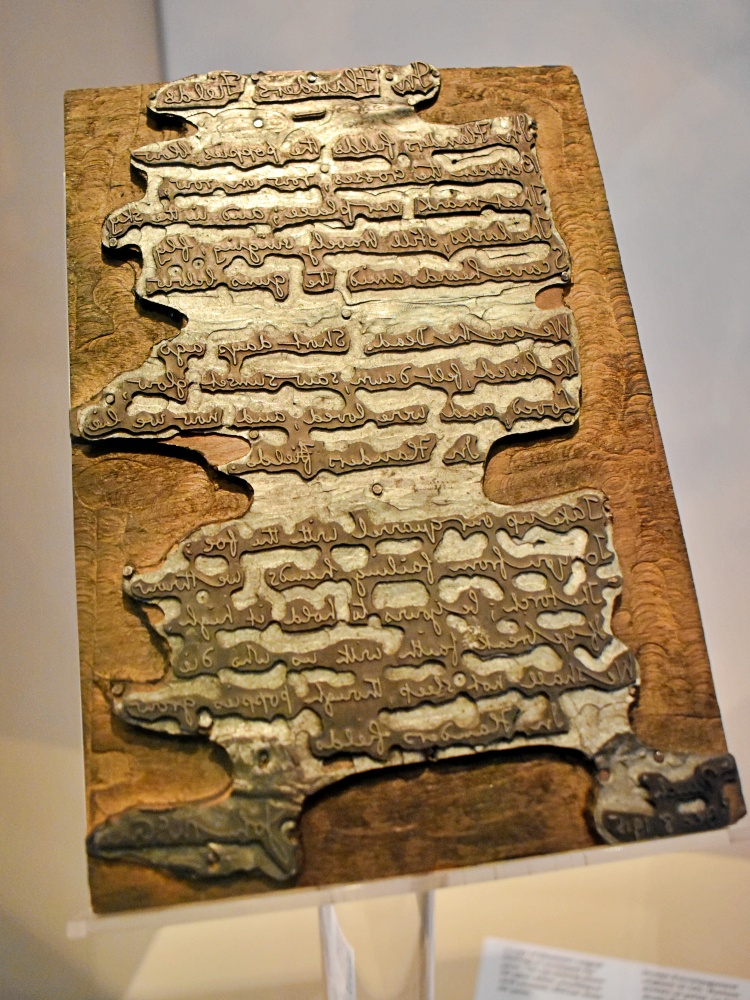
The CFB Shilo Royal Canadian Artillery Museum has had the honoured guardianship of the original printing plate of the poem In Flanders Field since the facility opened in 1962. The museum in be open free of charge on Nov. 11 from 12 p.m. to 4 p.m. Photo: K-J Millar/Shilo Stag News
