
Jules Xavier
Shilo Stag
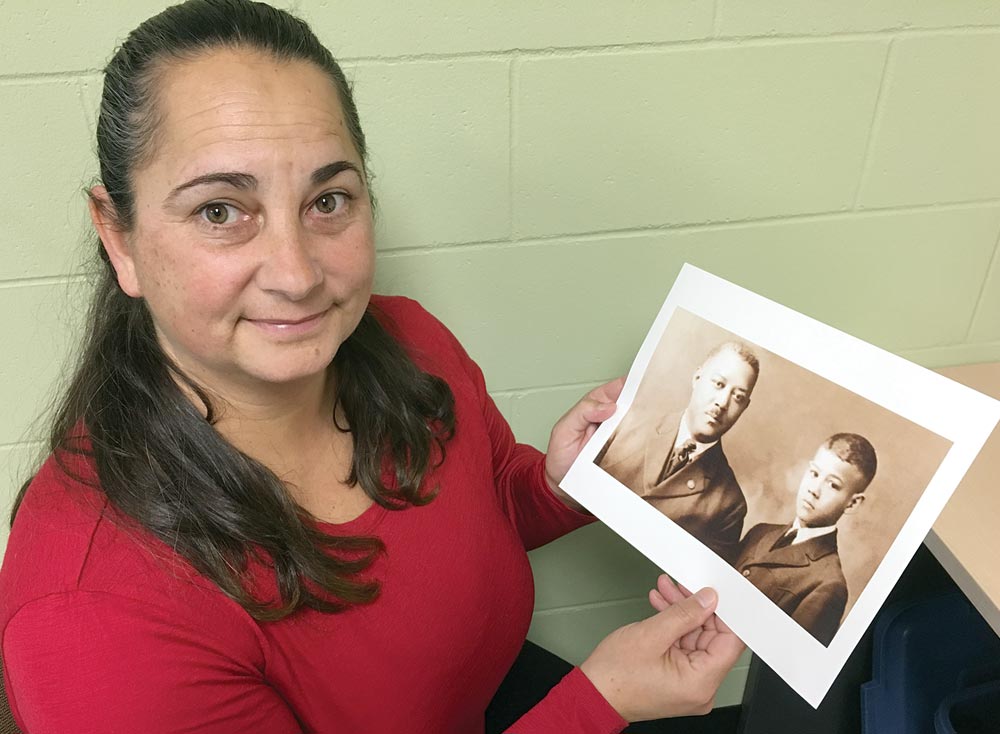
Tracing her family ancestry has led Ginger Lamoureux to discover her great-grandfather served in the Great War — specifically the No. 2 Construction Battalion.
“I have a sister who was given up for adoption and we have found each other and reconnected over the last 12 years,” recalled Lamoureux, who is Health Promotion manager working out a CANEX office. “We have been sharing some of the information about our family since then and this is a continuation of that bonding we have been lucky to build upon.”
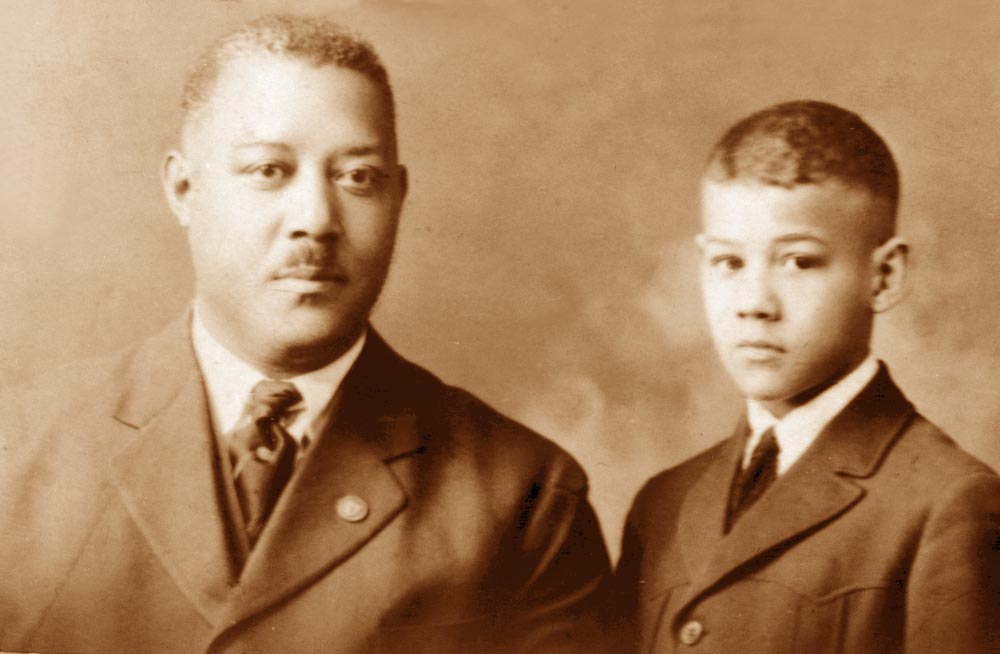
This sharing of family information provided her with plenty of family tree fodder, including locating rare photos in the form of large format black and white negatives. Among them is a now cherished photograph of her great-grandfather Cpl Damascus Virgil, and grandfather Owen Virgil. Born on Dec. 9, 1913, Owen was just three when his father left for France.
As a detective researching for your great-grandfather’s life, what did you learn about him?
“This has been an interesting adventure so far with much more to learn. The more we discover the more questions there are to answer. I learned that my great-grandfather seems to have had a sense of duty and as he served not only in the First World War for Canada, but in the Spanish American War prior to that while still living in the United States.
“I discovered he was a cook both in his military career, but also in his civilian one having worked in that capacity with the railroad. I discovered he was very progressive for his time; he was in an inter-racial marriage helping to raise his wife’s kids from a previous marriage. He was a family man committed to providing for his family sending home more than what he kept for himself during the Great War.
“I discovered he immigrated to Canada in 1904 and by 1917 he was enlisted in Canada’s only all-coloured battalion, that he lived in many parts of this country including Alberta, Manitoba, Ontario and Quebec.”
Cpl Virgil enlisted in the Spanish-American War in Savannah, Georgia on Aug. 8, 1899. The Spanish-American War was fought between the United States and Spain from 1898 to 1902. Hostilities began in the aftermath of the internal explosion of USS Maine in Havana Harbour in Cuba, leading to USA intervention in the Cuban War of Independence. Discharged June 30, 1901
While American soldiers deployed to Cuba, Guam and Puerto Rico, Cpl Virgil was sent to San Isidro, Nueva Ecija in the Philippines He was among 252 soldiers and 11 officers with 24th infantry, assigned to 49th volunteer infantry, E Coy. He was discharged on June 30, 1901.
How did Lamoureux learn Cpl Virgil was part of No. 2 Construction Battalion?
“Learning he was a part of No. 2 Construction Battalion was part of our journey of trying to discover more about my great-grandfather. My uncle had done some research years ago and we knew he had served for the USA when he was still living there so I decided to look into the First World War as I knew so many men had been conscripted to serve,” she said.
“When I did a Google search I discovered there was a military file for him and, not only that, but it had been digitized so I was able to download the whole file. To my surprise I found he signed up to serve his country prior to conscription and he served two years for his country. As I was doing this research along with my family, we heard the reports on CBC about the No. 2 Construction Battalion and were joking wouldn’t that be astonishing if he was a part of that group only to discover a day or so later looking through the military personnel file more closely that he was in fact a part of that group of history making men.”
Black soldiers like Cpl Virgil have played a major role in Canada’s military history for more than 200 years. They helped the British fight off the Americans in the War of 1812, assisted in stopping the rebellion in Upper Canada in 1837. They travelled to South Africa to fight in the Boer War from 1899 to 1902.
Like so many others swept up in the patriotism that the First World War initially brought on, young black Canadians were eager to serve King and country. At the time, however, the prejudiced attitudes of many of the people in charge of military enlistment made it very difficult for these men to join the Canadian Army.
Despite the barriers, some black Canadians did manage to join up during the opening years of the war — they wanted the chance to do their part on a larger scale, however, and pressured the government to do so.
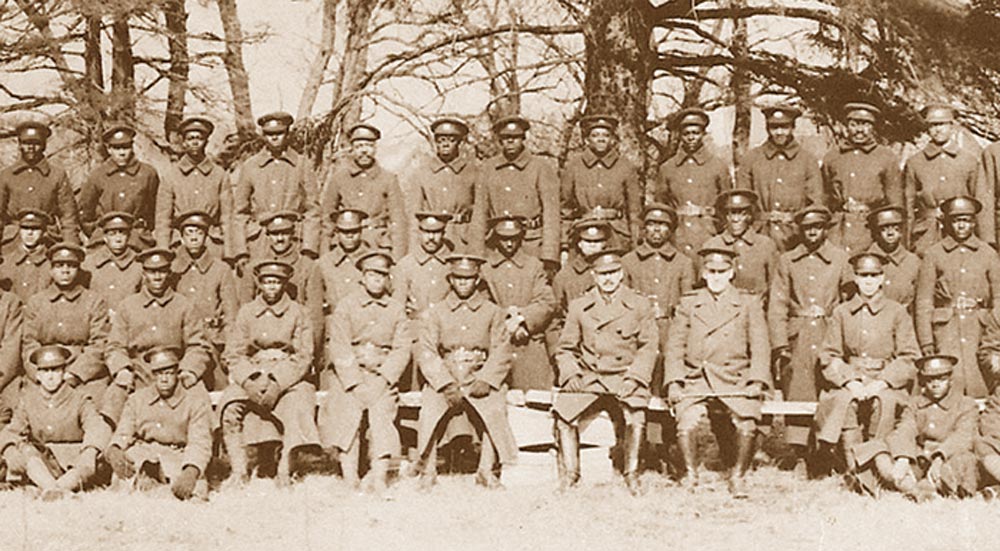
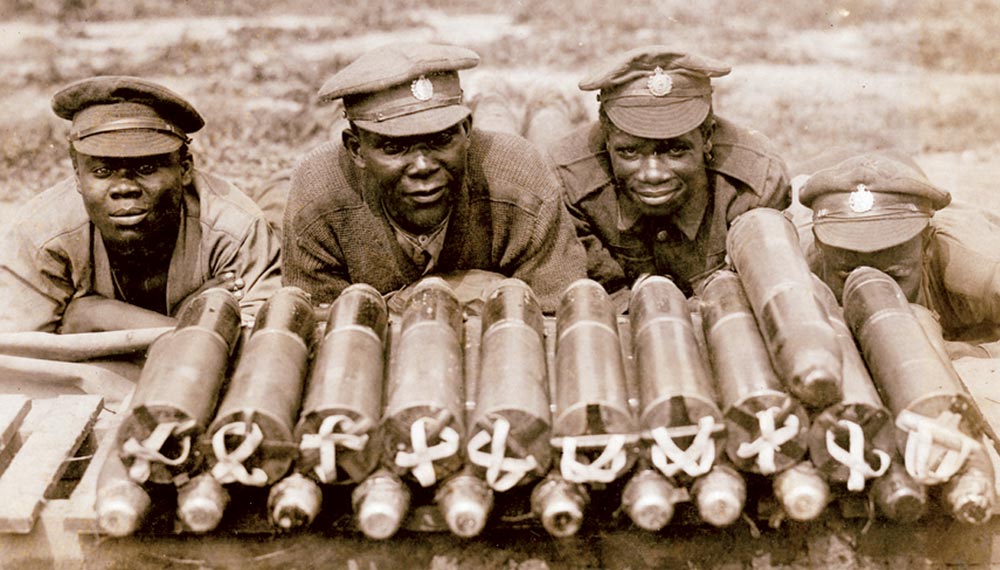
On July 5, 1916, the No. 2 Construction Battalion was formed in Pictou, Nova Scotia — the first large Black military unit in Canadian history. Recruitment took place across the country and more than 600 men were eventually accepted, most from Nova Scotia, with others coming from New Brunswick, Ontario, the prairies and even some from the United States.
The segregated battalion was tasked with non-combat support roles. After initial service in Canada, Cpl Virgil’s battalion boarded the SS Southland bound for Liverpool, England in March 1917. Its members were sent to eastern France later in 1917, where they served honourably with the Canadian Forestry Corps.
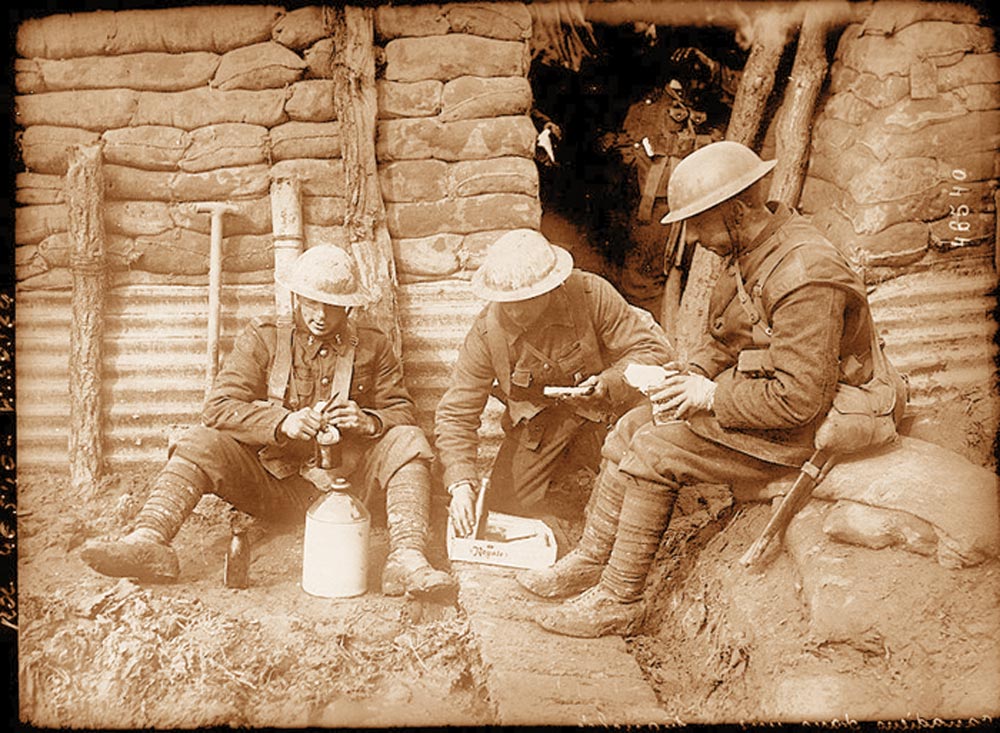
There they helped provide the timber required to maintain trenches on the front lines, as well as helped construct roads and railways. After the end of the First World War on Nov. 11, 1918, Cpl Virgil sailed to Halifax in early 1919 to return to civilian life and his unit was officially disbanded in 1920.
Conditions for soldiers on the front lines in the Great War were not the same as they are today — many spent time in trenches or in temporary tents. The men in Cpl Virgil’s battalion were not treated well. They were given equipment and clothing which was below the quality other men in the army were provided.
Cpl Virgil and his fellow soldiers were often asked to perform dangerous tasks where they were injured by artillery fire and poisonous gas. The medical staff in the army refused to take care of them except for Dr. Dan Murray — grandfather of famous Canadian singer Anne Murray.
What does Lamoureux think about her great-grandfather’s treatment overseas, his all-black battalion of construction workers not being issued weapons to protect themselves on a battlefield where they were exposed to snipers and artillery shells? “I am proud of all the soldiers who serve their country, but amazed that these men were willing to do so knowing they were not being treated with the same respect and dignity that everyone else was receiving. The fact they had accommodations and clothing that was not as protective from the elements and that other soldiers either didn’t want to interact with them or even want them there is disappointing, but not surprising given the period,” she said. “I can’t imagine being thrust into a country you have never been to and given tasks to complete close to the front, but only having shovels and picks to defend yourself with.”
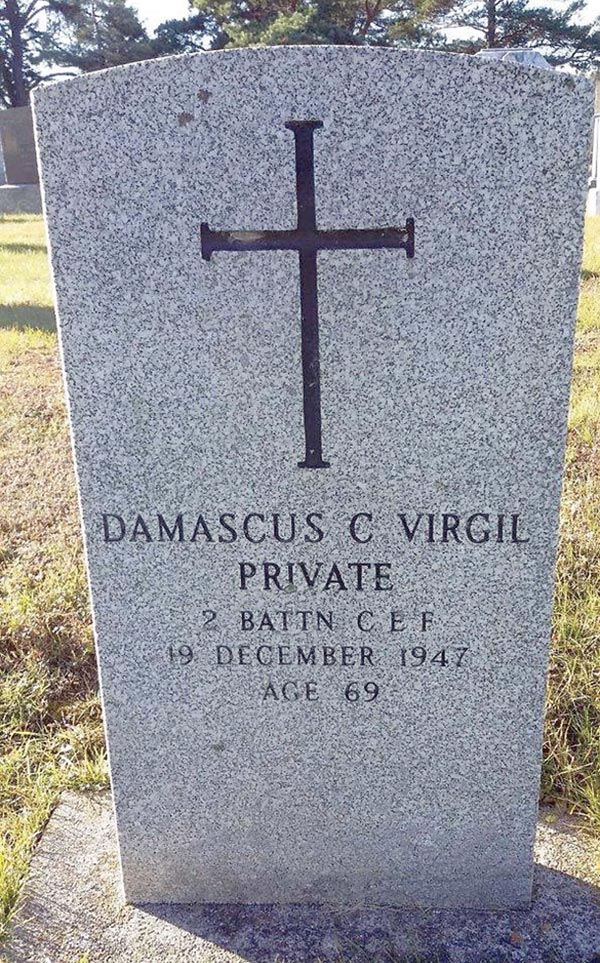
A private when he signed his attestation papers in Edmonton on Feb. 5, 1917, the five-foot-10, 210-pound soldier — he was down to 195 pounds after the war — Cpl Virgil embarked for England from Halifax on March 25, 1917, arriving in Liverpool on April 7, 1917. He travelled to France on May 19, 1917. Once the war was over, No. 2 Construction Battalion left for England on Dec. 14, 1918, the returned to Canada on Jan. 12, 1919. He was discharged in Montreal on Feb. 10, 1919 just shy of his 40th birthday. On Cpl Virgil’s Casualty Form – Active Service paperwork it tells he was promoted on May 16, 1917 to acting corporal; he spent his first leave in Paris from March 2 to 16, 1918; eight days after the war ended he was back in England; on June 8, 1917 he was reported for “gross neglect of duty” when he allowed his men to do something, the word unreadable because of the clerk’s fountain ink scratch.
While overseas, Cpl Virgil assigned $20 from his monthly pay to wife Isabella starting on April 1, 1917. She had moved back to Montreal with three-year-old Owen, and her children from a previous marriage, Alice, 15, and Will, 13, Deteault. His regimental pay was $1.10 per day, field allowance 10 cents per day and $35 clothing allowance. His promotion meant his regimental pay bumped up a dime per day.
While Lamoureux never met her great-grandfather, she knew here grandfather Owen well. Her father Lionel Lamoureux, who was born in 1949 in St. Paul, Alberta, married Owen’s daughter Juliette, who was born in 1950. According to the Canada 1916 census, Cpl Virgil and Isabella (nee Lachance) and their three kids called Edmonton home. Isabella, who was four years older than her husband, immigrated to Canada, via France where she was born, in 1901. Cpl Virgil arrived in 1904 from the USA.
According to an obit in Winnipeg Free Press, Lamoureux’s great-grandmother Isabella Virgil died on Dec. 9, 1929, age 54. She was buried at Brookside cemetery after a Dec. 10 funeral at Barker’s Chapel in Section 21, Lot 9400. Born on March 22, 1879 in Hawkinsville, Georgia, Cpl Virgil died on Dec. 19, 1947. He was buried in what is now Thunder Bay as he was living in Port Arthur when he died at age 69. If Cpl Virgil was alive today, what would Lamoureux tell him about his contribution to the Great War? What would she ask about his life in the Spanish American War, and Great War? Why do you think he enlisted to serve both the USA and Canada?
“If my great-grandfather was alive today I would want to tell him I think it is amazing he stepped up and was counted when it wasn’t mandatory to do so. At a period in our collective history when he, as a black man, was seen as a second class citizen in many respects he still knew in his heart he had things he could contribute to winning the fight and was willing to do so,” she said. “This isn’t a situation where he needed the work — he was working for the railroad at the time of his enlistment so this was something he and his wife made a conscious decision to do. This wasn’t the first time he had served in the military, albeit for a different country, he knew what was ahead of him having served in the Philippines. I would ask him about his service and ask if there was anything he wished he could have done additionally or differently. What was the tipping point that made him sign up or was this something he always wanted to do.”
When you see what soldier’s were paid during the Great War, and a soldier’s life could be taken in a blink of an eye from a bullet or artillery shell, the Stag asked Lamoureux why would her 38-year-old great-grandfather enlist in a second war, leaving his family back in Montreal?
“I am not sure what inspired him and his wife to choose this path. I don’t know what he was making with the railroad at the time, but I can’t imagine it being much less than that,” she offered. “They obviously felt compelled by their connection to this country and to what they believed in to do so. This is something that I am truly proud of both of them for committing to.”
Looking back at her great-grandfather’s life serving two countries on the battlefield, Lamoureux acknowledged she is impressed by the resolve that both of her great-grandparents had with the advent of the early 1900s.
“They stuck to their beliefs and didn’t let society dictate who they were, where they lived or who they loved. Which is amazing and awe-inspiring considering that they were in an inter-racial marriage made up of two blended families, with one child [grandfather Owen] who was deaf in the early 20th century,” she said. “They were people who asserted themselves and believed they had something to contribute to society and were determined to do so. I am building a family history with my siblings to keep this history alive so we can share it not only with our kids, but our cousins and their children as well. I want to ensure we have documents they can pour over and see handwriting to really make that human connection to who our family was and is.
“I want to inspire my son to take on some of the traits my great-grandparents displayed so he can forge his future into anything he wishes it to be and for him to learn that he is not confined or pigeon holed by anything or anyone except himself.”
Lamoureux said she continues to do research on Cpl Virgil’s life.
“This experience has been quite a ride and it hasn’t stopped yet. I am looking forward to learning more about Damascus and Isabella and their story, but also about other members of my family on both my mom and dad’s sides. I am glad my siblings are along for the thrill of the treasure hunt and can say this has brought us that much closer together. This research has inspired my mom and dad to fill out questionnaires about their lives and experiences to include in our family history on things like where they met and what their favourite things were growing up which will be invaluable for generations to come.”
Nov. 11 has especially become poignant for Lamoureux now that she has a connection to someone who was there as it was ending.
“Remembrance Day has always been important in my family. We were raised to honour those who came before us and all the work they did to give us the lives we have today. I knew other relatives served in past wars, but learning about this part of my family history has strengthened the significance of it all for me,”she said. “I always knew we had a strong connection to the history of this country, but now it is something even closer to my heart that I want to ensure my son understands as he grows up.”