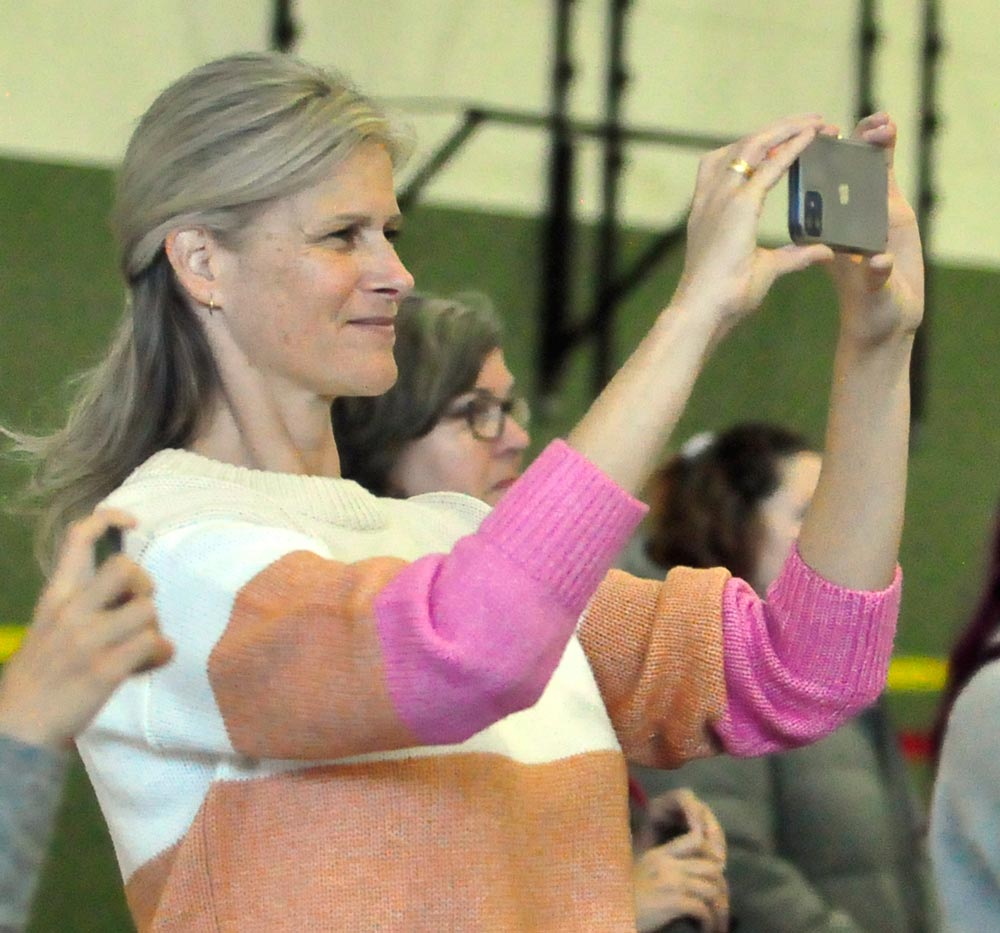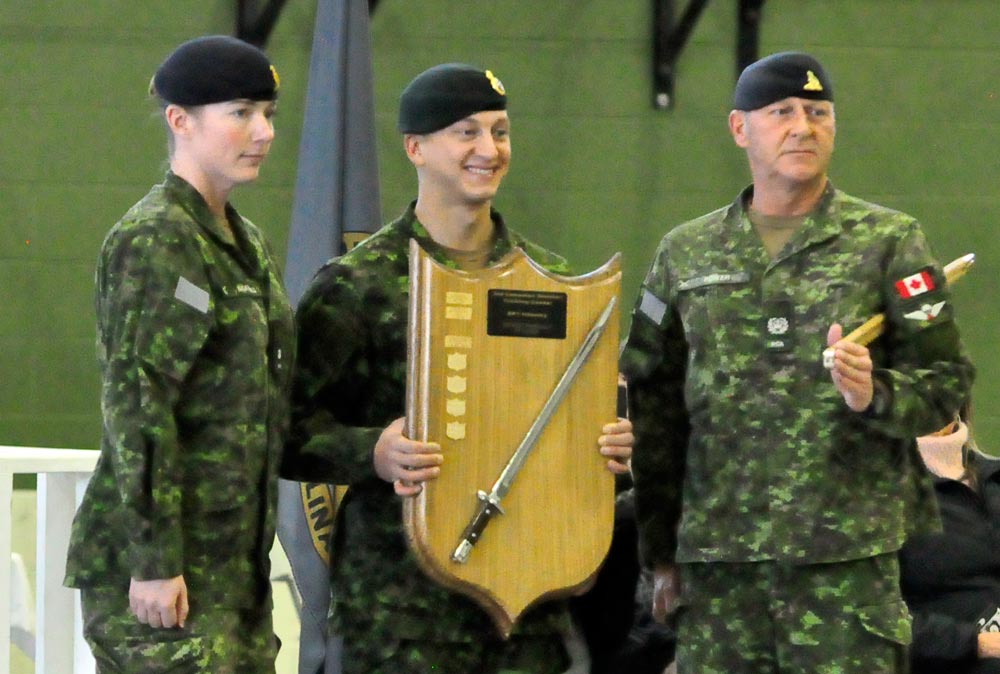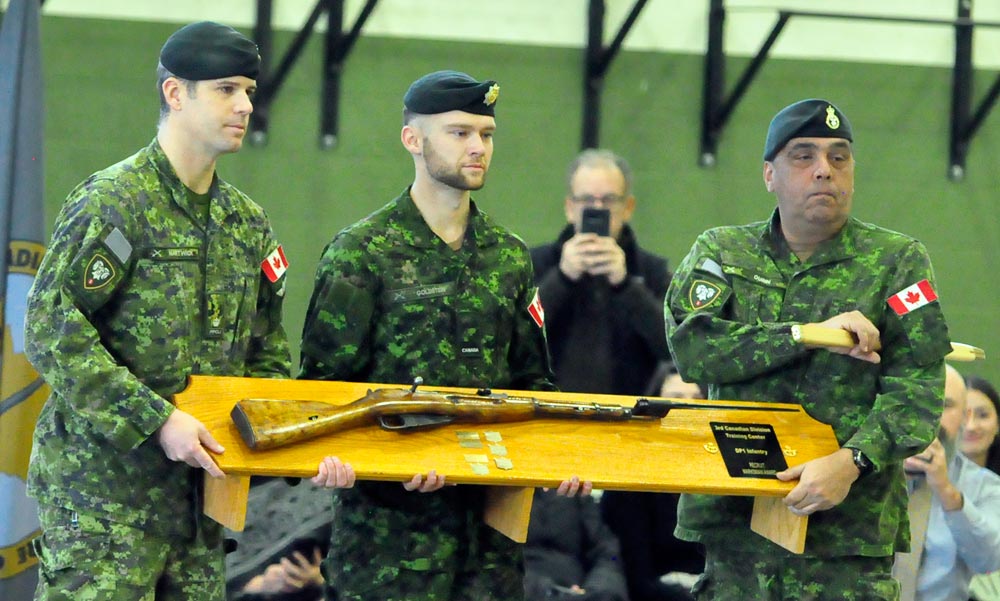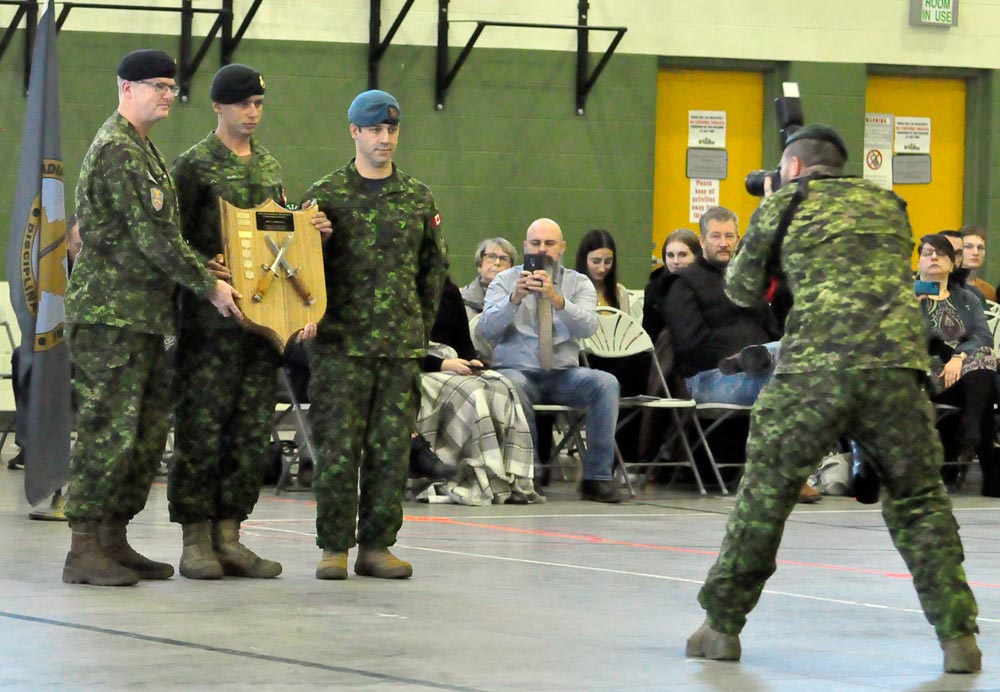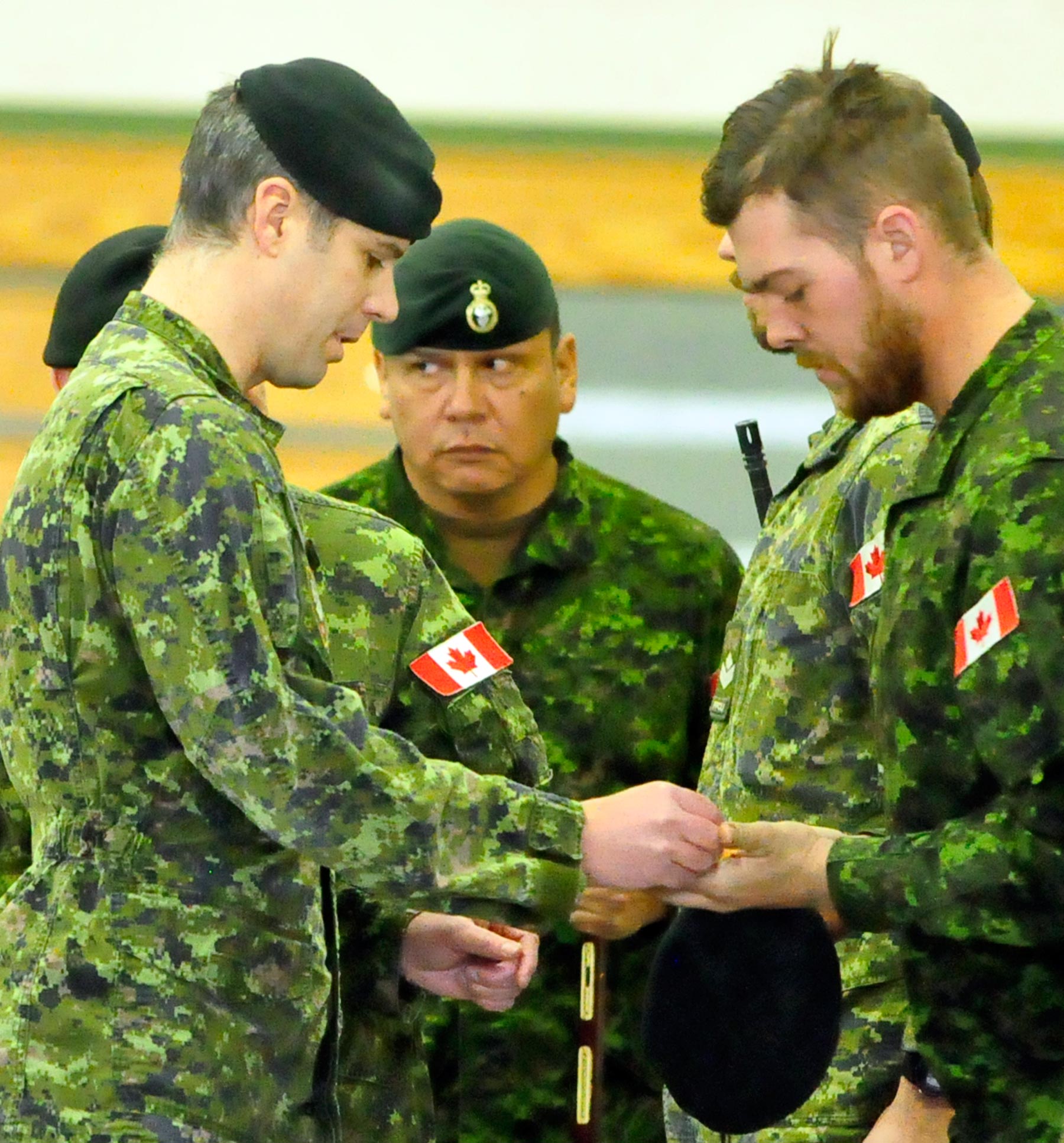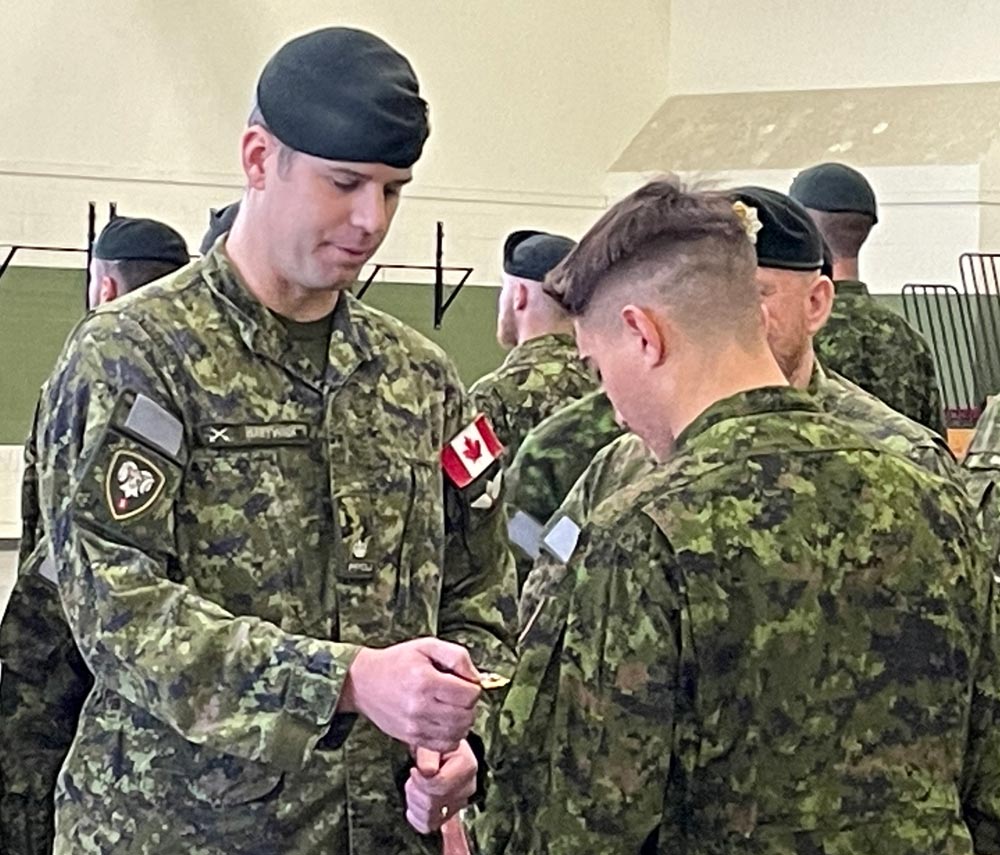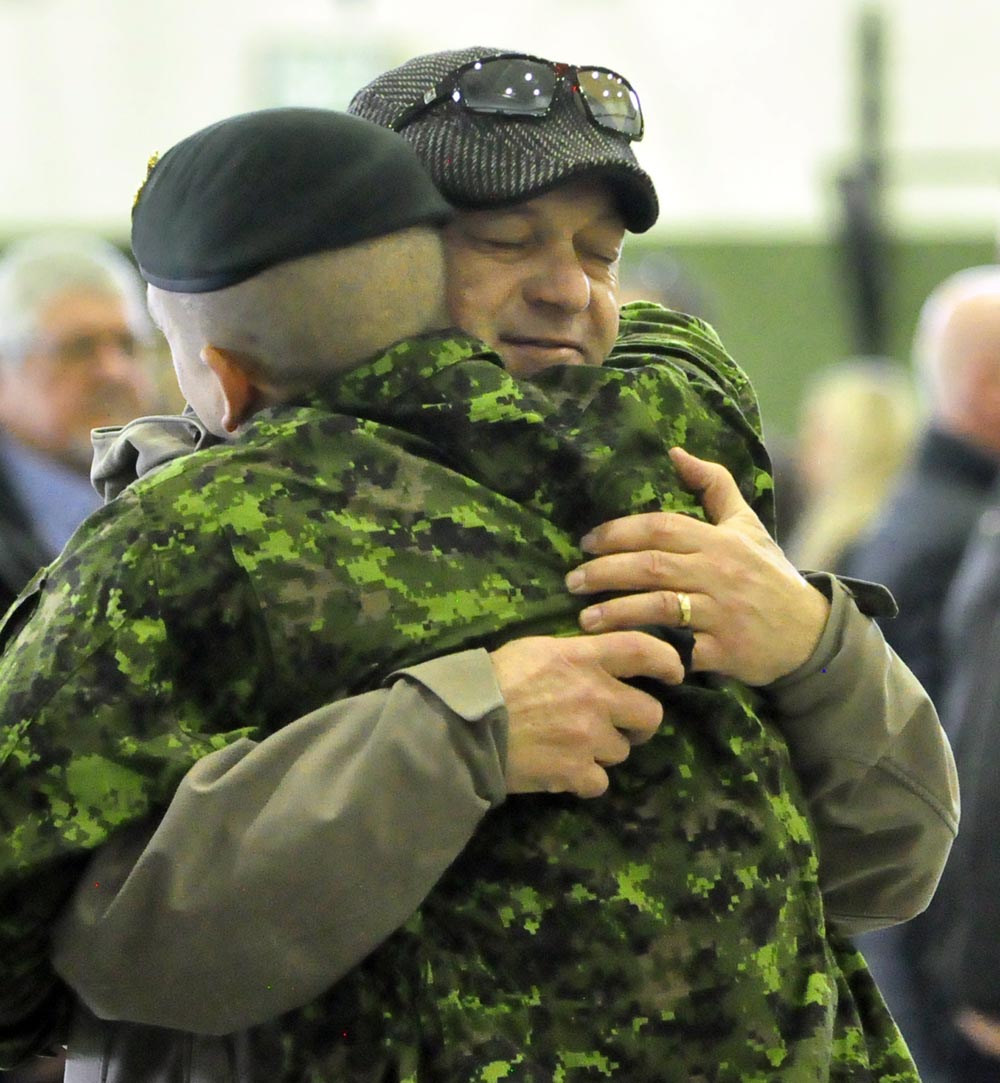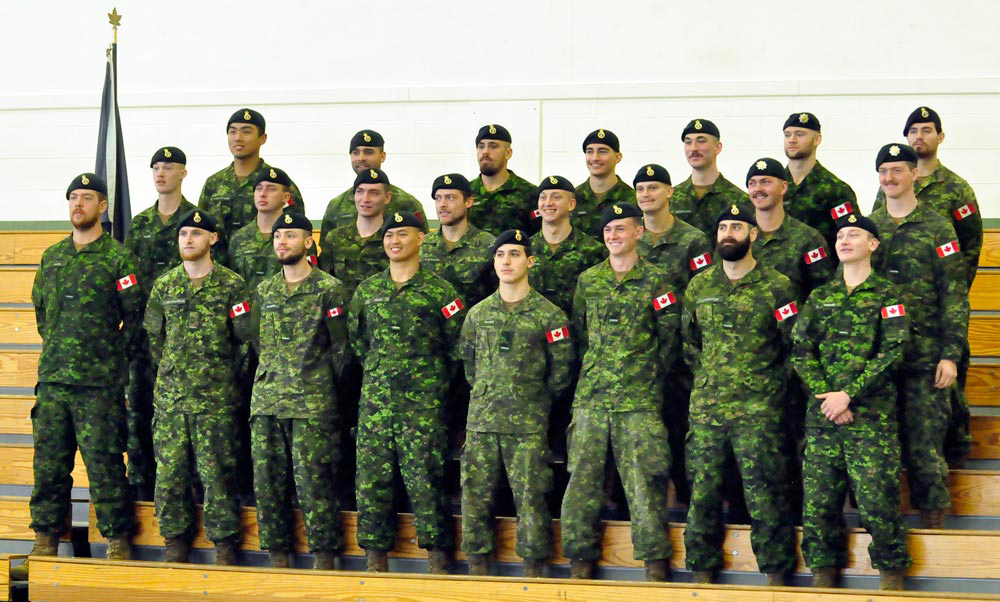

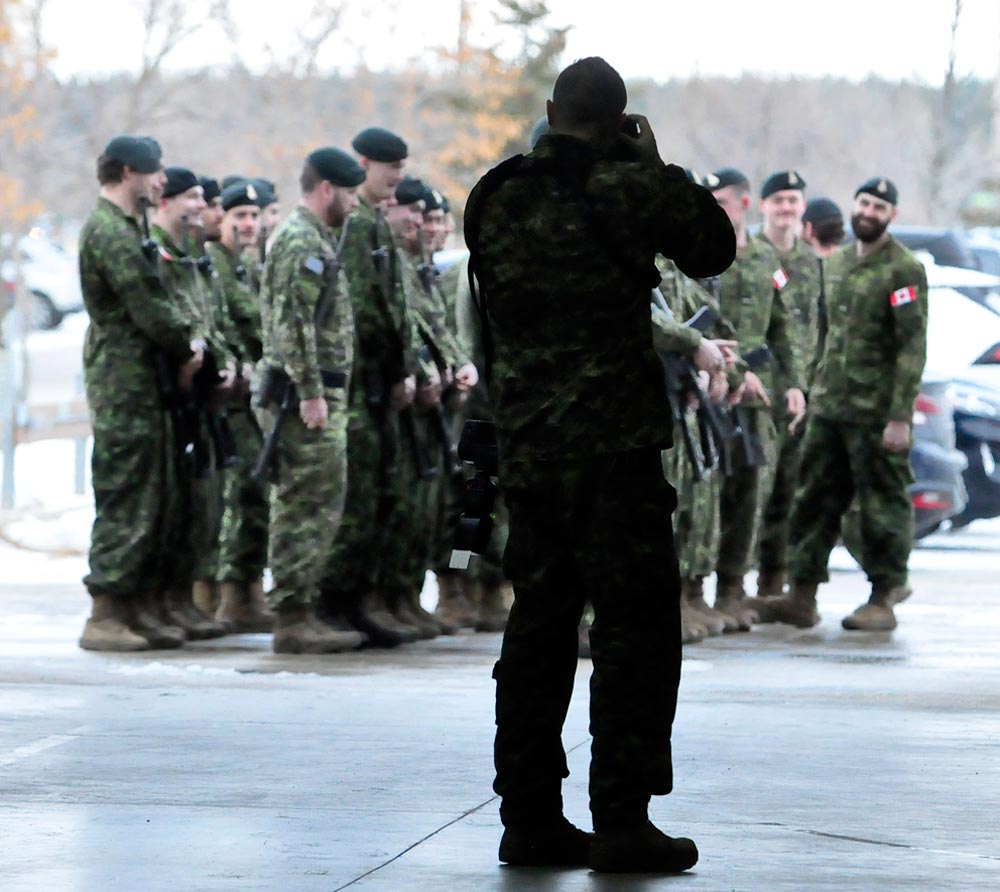
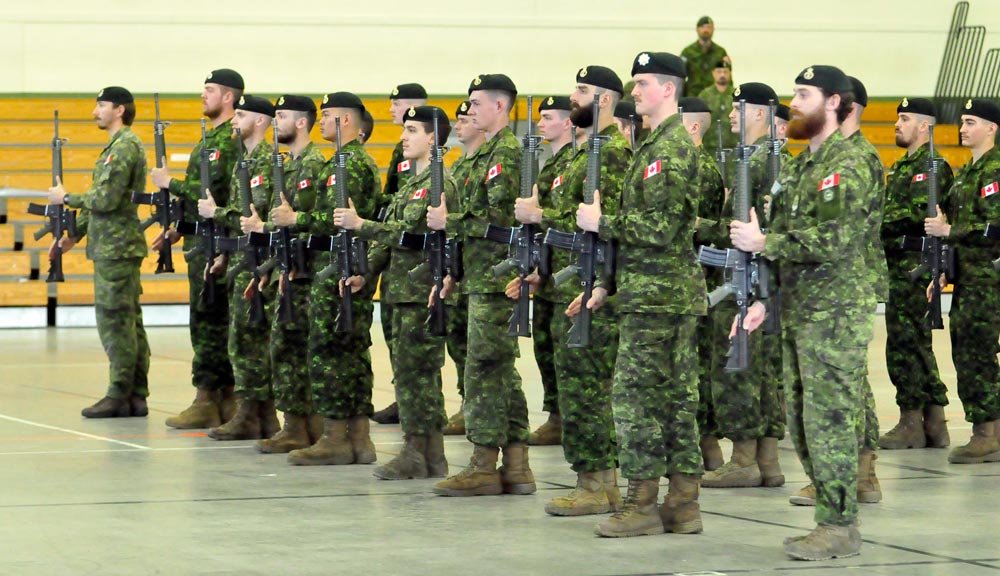
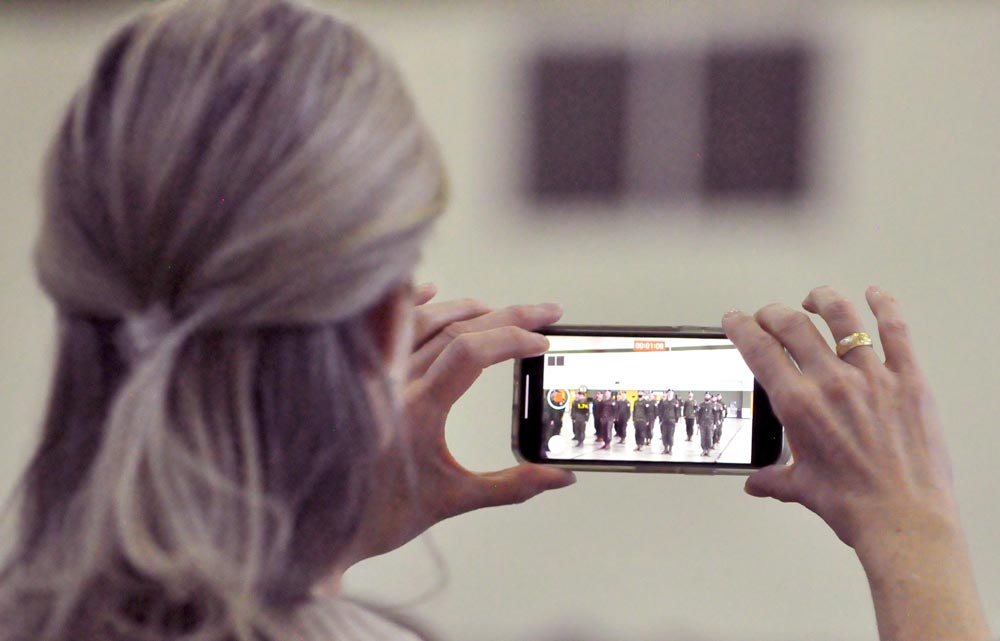
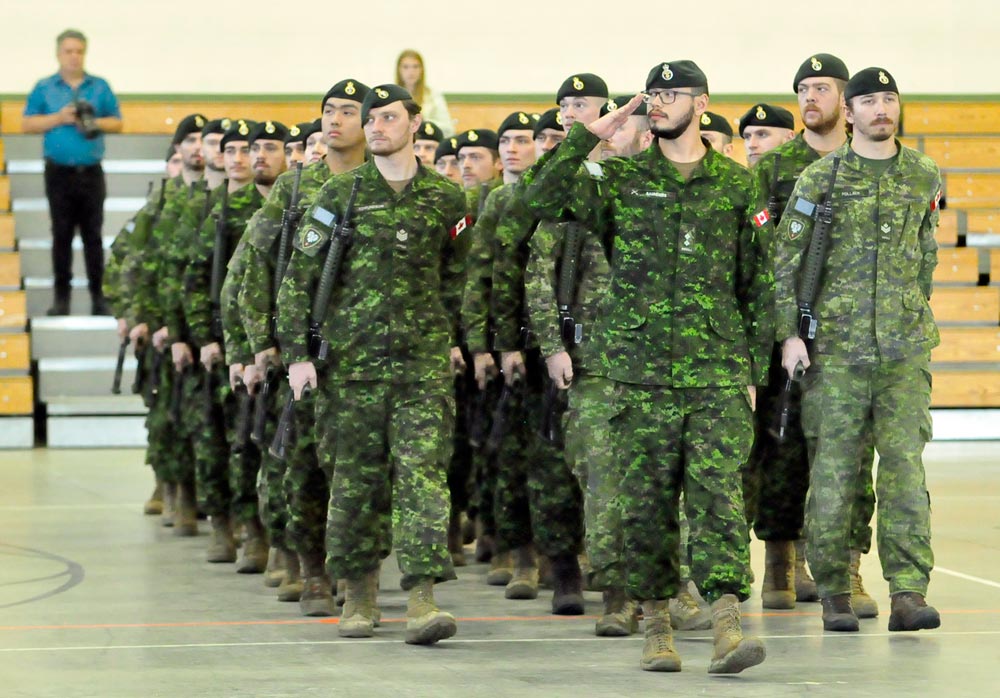
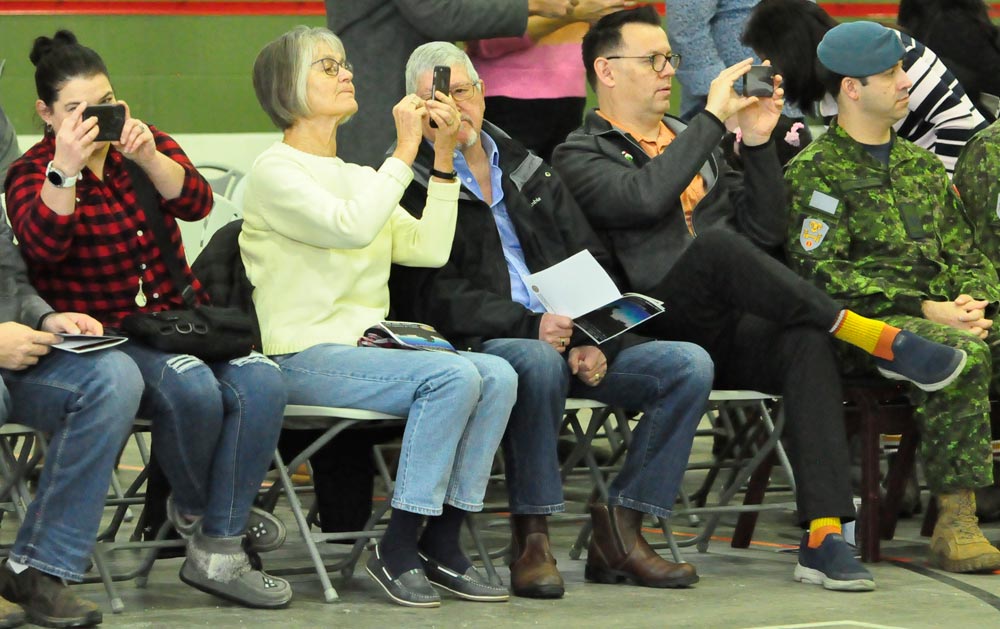
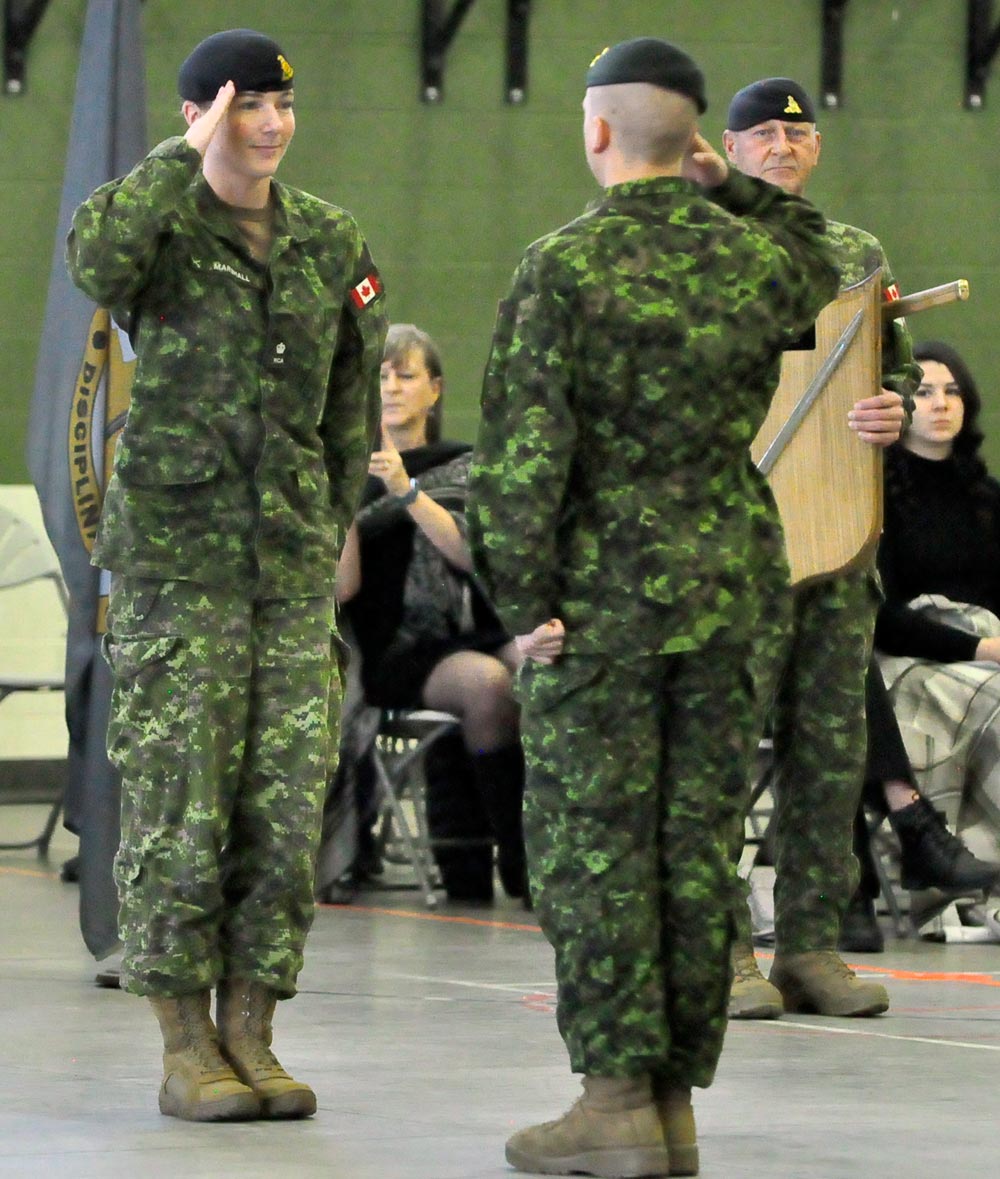
2PPCLI A/CO Maj Chris Hartwick was the reviewing officer for the 3CDTC C Coy Det Shilo DP1 Inf graduation, where four privates received awards following the 11-week course. More than 60 friends and family members were in attendance at the MPTF, with their iPhones capturing the event. Afterwards, hugs were exchanged with family members, after having a graduation photograph to mark the occasion of 23 new infantry soldiers joining the Canadian Army. Photos Jules Xavier/Shilo Stag
Shilo Stag
2PPCLI’s ranks grew by 12 infantry soldiers following the intense 11-week DP1 Infanteer course.
The course run by 3CDTC C Coy Det Shilo initially started with 48 candidates, but with injuries, dropouts and CAF recruits deciding to re-muster from infantry to another trade following their DBMQ, it was 23 who stood on the MPTF’s parade square in front of more than 60 family members.
A proud OC Maj Melissa Marshall looked on as the graduates received their badges from reviewing officer 2PPCLI A/CO Maj Chris Hartwick — 20 placed the PPCLI on their beret, while three received their Royal Canadian Regiment (RCR) badges from 3CDTC RSM CWO Ian Bennett.
What is DP1 Infanteer? Developmental Period 1 Infanteer, or DP1 Inf, is the baseline infantry trade course for Non-commissioned Members (NCMs) and qualifies them to be members of the Royal Canadian Infantry Corps (RCIC).
It teachers candidates how to operate weapons organic to the infantry platoon, infantry tactics and maneuvers, as well as how to operate as a rifleman within a rifle platoon.
DP1 Inf candidates are closely evaluated on their weapons handling, participation in offensive, defensive and transitional operations during Field Training Exercises (FTXs).
Who does the DP1 Inf train, and to what purpose?
DP1 Inf trains future infantry of the Canadian Armed Forces (CAF) be fit, tactical, flexible and ethical warriors.
Once candidates complete the Base Military Qualification (BMQ), they arrive at 3 Canadian Division Training Centre (3CDTC) to learn the infantry trade.
Graduates of DP1 Inf will have developed baseline infantry skills during the course which they will use for the remainder of their military career.
The individual soldier is the lifeblood of the RCIC and is extremely important to the operational capability and performance of any infantry unit, and the CAF as a whole, at home and when deployed abroad.
Where are these DP1 Inf graduates heading next? Successful candidates, now professional soldiers, will be posted to an infantry battalion.
Members of this graduating class DP1 0122 will be posted to 1PPCLI, 2PPCLI or 3PPCLI; 1RCR, 2RCR or 3RCR; and 3rd Battalion Royal 22nd Regiment (R22eR) based in Quebec at CFB Val Cartier.
1PPCLI and 3PPCLI are located in Alberta at Garrison Edmonton, while 2PPCLI’s home is CFB Shilo.
1RCR and 3RCR are located in Ontario at Garrison Petawawa, while 2RCR is in New Brunswick at CFB Gagetown.
DP1 Inf is a gateway for more advanced training such as reconnaissance patrolman, sniper, basic parachutist, complex terrain instructor, and other specialized fields.
Equipped with their newly acquired skills, graduates are now set to join their new unit and fall into its extremely busy, challenging and rewarding role of serving Canada.
It’s especially busy if an infantry unit is training for upcoming deployments, with a number of operations across the globe involving infantry soldiers. Like Op REASSURANCE in Latvia.
From this graduation class the following grads are posted to 2PPCLI: Pte Dongtotsang, Pte Aguas, Pte Clarke, Pte Macek, Pte Bourgeois, Pte Kinrade, Pte Ward, Pte Woods, Pte Blackmore, Pte Nagy, Pte Tucker and Pte Eastlake-Kellar.
1PPCLI’s ranks now include Pte Brinkhurst, Pte Gunning, Pte Buren, Pte Chiasson, Pte Buchanan and Pte Seiben.
3PPCLI’s ranks now include Pte Johnston and Pte Magliocco.
3RCR added the following graduates Pte Payne and Pte Goldstein, while 1RCR is receiving Pte Lyle.
The 11-week course also provides DP1 Inf candidates with four awards which are presented by command teams during the graduation ceremony.
The Sgt Robert Spall Award is named after a PPCLI Victoria Cross recipient, awarded for most conspicuous bravery and self-sacrifice. Sgt Spall’s Oct. 26 dispatch in the London Gazette read, “For most conspicuous bravery and self-sacrifice on the night of Aug. 12 to 13, 1918, near Parvillers. When his platoon was isolated during an enemy counter-attack, Sgt Spall took a Lewis gun, and standing on the parapet fired upon the advancing enemy, inflicting severe casualties. He then came down the trench directing the men into a sap 75 yards from the enemy. Picking up another Lewis gun this gallant NCO again climbed the parapet and by his fire held up the enemy. It was while holding up the enemy at this point that he was killed. Sgt Spall deliberately gave his life in order to extricate his platoon from a most difficult position, and it was owing to his bravery that the platoon was saved.”
This award is selected by course instructional staff. It is awarded to the soldier who has been deemed to best combine teamwork, field craft, individual soldier skills and leadership. They chose Pte Aguas, who is now with 2PPCLI.
Up next, the Marksmanship Award was presented to Pte Goldstein, who is now with 3RCR at Garrison Petawawa. This award goes to the soldier who best combined shooting ability with physical fitness, achieving the highest score during Personal Weapons Testing (PWT) with the C7A2 service rifle.
Pte Johnston was deemed to be the “most physically fit” DP1 Inf candidate, and garnered the physical fitness award. Off to 3PPCLI at Garrison Edmonton, he received this accolade after impressing his Chain of Command with his physical capabilities, not only on morning runs and during strength training, but more significantly, while in the field under heavy pack and through periods of physical and mental duress.
There’s also a most improved candidate award, which was presented to Pte Ward, who is joining 2PPCLI. Referred to as the Sgt Harry George Mullin/Coursemanship Award, it’s named after another PPCLI soldier from the Great War who was awarded a Victoria Cross for his gallantry on the battlefield in October 1917.
His VC citation from the London Gazette on Jan. 11, 1918 read, “For most conspicuous bravery in the attack on the Meetcheele Ridge, Passchendaele, on the morning of morning of Oct. 30, 1917, when single handed he captured a commanding “pill-box” which had withstood the heavy bombardment and was causing heavy casualties to our forces and holding up the attack. He rushed a snipers’ post in front and destroyed the garrison with bombs, and, crawling on to the top of the “pill-box”, he shot the two machine gunners with his revolver. Sgt Mullin then rushed to another entrance and compelled the garrison of 10 to surrender. His gallantry and fearlessness were witnessed by many, and although rapid fire was directed upon him and his clothes were riddled with bullets, he never faltered in his purpose, and he not only helped to save the situation, but also indirectly saved many lives.”
In the Canadian Army (CA),you never fight alone. For the Infantry Corps, a fire-team partner will always be by your side and this building block is the foundation of trust and operational effectiveness upon which all teamwork is founded.
Your fire-team partner shares a trench, watches your back, and picks you up when you fall down. Applying this level of camaraderie and teamwork to the platoon or course level, the Coursemanship Award is voted on by the candidates to recognize the unsung candidate who put forth their greatest effort for the betterment of the team.
Of note, PPCLI’s history features three VC recipient. Besides Sgt Mullin and Sgt Spall, there’s also Lt Hugh McKenzie.
His Feb. 13, 1918 dispatch in the London Gazette read: “For most conspicuous bravery and leading when in charge of a section of four machine guns accompanying the PPCLI in their attack on the Meetcheele Ridge, Passchendaele, on the morning of Oct. 30, 1917. Seeing that all the officers and most of the NCOs of an infantry company had become casualties, and that the men were hesitating before a nest of enemy machine guns which were on commanding ground and causing them severe casualties, he handed over command of his guns to an NCO, rallied the infantry, organized an attack and captured the strong point. Finding that the position was swept by machine gun fire from a pill-box which dominated all the ground over which the troops were advancing, Lt McKenzie made a reconnaissance and detailed flanking and frontal attacking parties which captured the pill-box, he himself being killed while leading the frontal attack. By his valour and leadership this gallant officer ensured the capture of these strong points and so saved the lives of many men and enabled the objectives to be attained.”
3CDTC is dedicated to training new soldiers and junior leaders for the Army’s Regular and Reserve Forces. The unit is comprised of five training companies — Alpha, Bravo, Charlie, Delta and Bold Eagle — and one support admin company in three locations. Besides CFB Shilo, the other two are at Garrison Edmonton and CFB Wainwright.
What’s the history of 3CDTC with its motto: “Disciplina Bellator — Training Warriors”?
Soldier training at CFB Wainwright traces its origins to the Second World War, with the establishment of wartime ammunition and training facilities and a Prisoner of War (POW) camp.
In 1974, the 1st Canadian Mechanized Brigade Operational Training Detachment was established at was called Camp Wainwright. It became the PPCLI Battle School on May 1, 1981. It was tasked to conduct trade level infantry and junior leadership, plus specialty courses for 1CMBG.
In 1997, CFB Wainwright and the Battle School were joined to form Land Forces Western Area Training Centre as the training centre for Western Canada.
3CDTC was established in 2013, as part of the re-introduction of the traditional names of many CA units. Despite the many name changes since the Second World War, the role has remained the same — training warriors for the Canadian Army.