
Andrew Oakden
Stag Special
In 1967, the RCA Museum received a donation from Cpl William May, who enlisted at Camp Sewell in Manitoba on Sept. 16, 1915 at the age of 23.
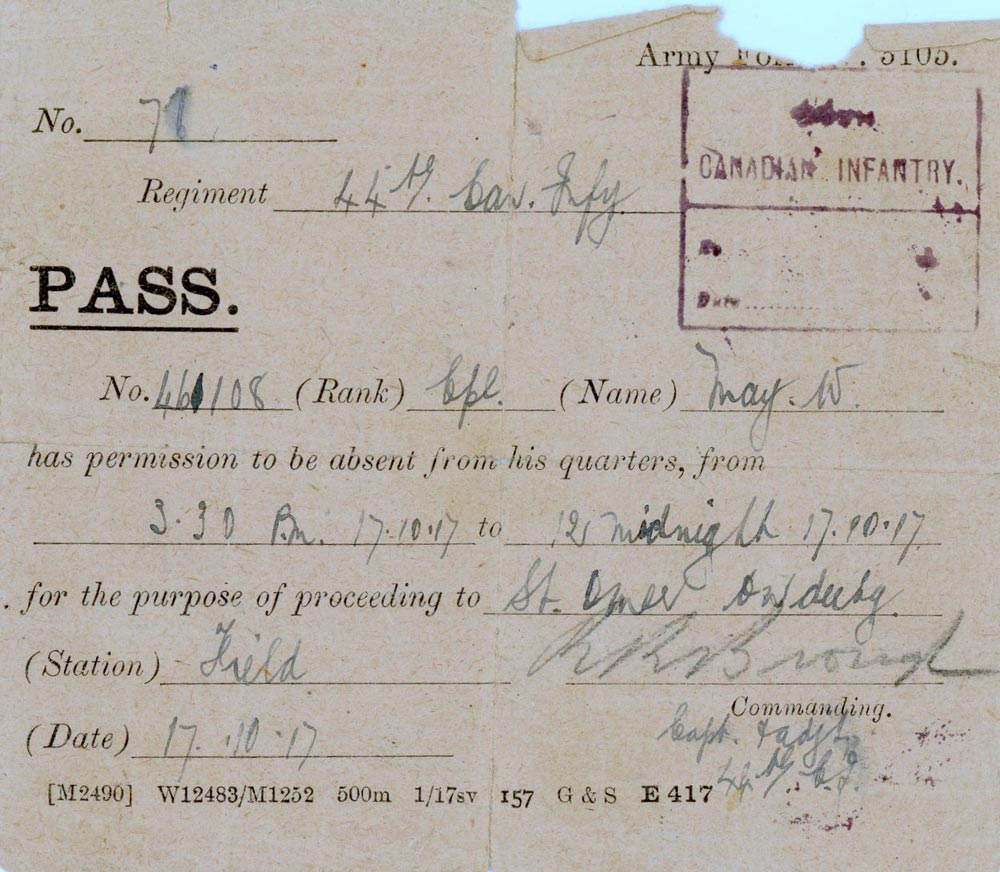
The gift was one of the earliest donations to the museum, including two paper artifacts from the First World War. The first document was a leave pass dated on March 17, 1917, issued by the 44th Infantry Battalion, allowing Cpl May to travel from the frontlines to possibly Paris, France.
During the First World War, Commanding Officers (COs) granted soldiers leave passes to visit Paris or other cities during time off from the front lines. These passes allowed soldiers to travel to a specific location before returning to their unit.
The time-off allowed soldiers to take a break from the stresses of war and relax in a more peaceful setting. If they did not return by the specified time, they would be AWOL or absent without leave and subject to military justice which could include various field punishments.
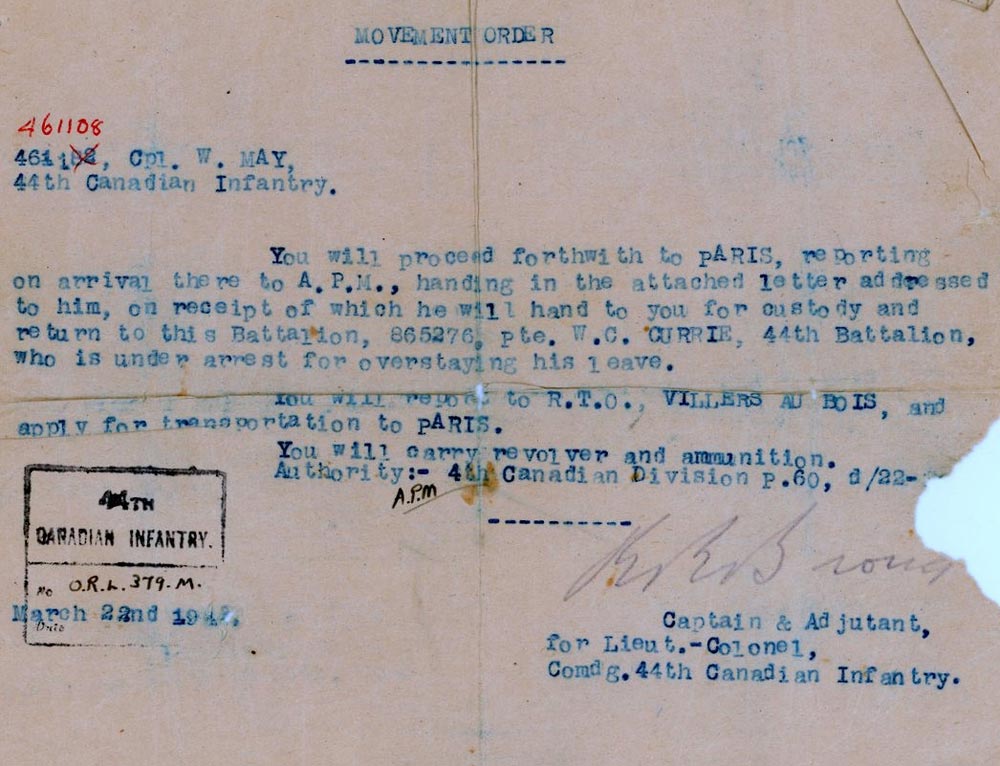
The second document in the donation was a movement order, or in this case, a field arrest warrant, which instructed Cpl May to travel to Paris and collect Pte William Currie, who had failed to return from a two-week leave period. A movement order or military field arrest warrant was a legal document issued by a military authority which allowed for the arrest and detention of an individual in a specific location, such as a battlefield or a theatre of war.
During the First World War, COs issued arrest warrants for soldiers accused of crimes or misdemeanours committed while on active duty or for individuals deemed a threat to the Army unit or the war effort.
Any military member, including Cpl William May, could serve these documents. The individual named in the warrant would be taken into custody and held until brought before a military court or a CO for trial or further proceedings.
Pte Currie, the soldier listed on the arrest warrant, enlisted in the Canadian militia on March 18, 1916, the day after his apparent 18th birthday, in Brandon, Manitoba. His next of kin was his mother, who lived at 215 Third Street in Brandon.
The doctor conducting his medical said Pte Currie was fit and stood approximately five-foot-eight. e joined the 181st Battalion, also called the Brandon Battalion.
The 181st trained recruits at Camp Hughes and the CO was LCol David Wilson Beaubier. The 181st Battalion was part of a Canadian Expeditionary Force (CEF), a “draft-giving” Battalion which provided soldiers to other units needing additional workforce. Today, the 26th Field Artillery Regiment in Brandon perpetuates the 181st.
Pte Currie spent the next year training in Canada and had two instances of docked pay, including in August 1916 and October 1916 — his file does not list the reason for being docked.
He sailed from Halifax on the HMT Grampian on April 18, 1917 and landed in Liverpool on April 29, 1917. The 44th Infantry Battalion took him on strength, and he joined them in France on the Western Front in June 1917.
The Western Front was a series of trenches and fortifications which stretched from the North Sea to the Swiss border.
The 44th Infantry Battalion initially embarked for Great Britain on Oct, 23, 1915, then to France on Aug, 12, 1916, as part of the 10th Canadian Brigade, 4th Canadian Division. They mobilized out of Winnipeg and contained many soldiers from Brandon.
These soldiers fought in many of the most significant battles on the Western Front, including the Somme, Arras, Vimy Ridge, Ypres, Passchendaele, and Amiens.
Canadian soldiers were part of the British Empire’s Forces (BEF), and they fought alongside soldiers from other parts of the empire and soldiers from France and other Allied countries.
In the Record of Service, Pte Currie received three instances of disciplinary action and two instances of hospitalization in France. For example, on Oct. 25, 1917, he received seven days of Field Punishment No. 1 for being absent without leave while at the Front and forfeited two days’ pay.
Also, on Dec. 6, 1917, he lost two days’ pay and had a wage stoppage until he paid the cost of three missing items, including one table knife, fork, and tin can cover.
During the First World War, the Canadian military punished soldiers guilty of disciplinary offences in various ways. Minor crimes, such as being late for roll calls or failing to follow orders, might be penalized with extra duty, confinement to barracks, or loss of pay.
More serious offences, such as desertion or disobeying a direct order, could result in imprisonment or execution by fire squad. Canada executed 25 soldiers for military crimes during the First World War.
Field Punishment No. 1 involved shackling a soldier’s hands and feet and attaching them to a fixed object, such as a gun carriage or fence post, for up to two hours per day, for up to 28 days. The punishment was a form of public humiliation intended to deter soldiers who had committed minor offences, such as being absent without leave or disobeying orders.
The British Army considered it a less severe punishment than flogging or imprisonment. However, the penalty caused ongoing mental health issues and attracted criticism for being inhumane. The British Army abolished Field Punishment No. 1 in 1923.
Pte Currie received 14 days’ leave to Paris in early March 1918. He never returned from leave on the required date. His birthday was on March 17 and his last day of approved break was on March 16. He likely overstayed to party on his birthday.
The Military Police (MP) in Paris arrested Pte Currie on March 21, 1918. Two days later, 44th Battalion CO LCol R.D. Davies sent Cpl May with the arrest warrant now in our collection to retrieve Pte Currie in Paris.
On March 30, 1918, Pte Currie returned to the 44th Battalion at the Front and LCol Davies gave him the maximum allowed Field Punish No. 1 sentence of 28 days. During this timeframe, Pte Currie also lost his wages.
However, on April 3, 1918, the 44th transferred him to a hospital due to illness, after he tested positive for VDG, which stood for Venereal Disease Gonorrhea.
During the First World War, venereal diseases (VD) such as Gonorrhea and Syphilis, were a significant problem for military personnel. These diseases were often transmitted through sexual contact and could have severe consequences for soldiers, including infertility, blindness, and other health problems.
Soldiers with VD were usually confined to military hospitals or other medical facilities until they were deemed fit for duty again. In some cases, soldiers unable to return to duty because of VD received a medical discharge. Pte Currie received four months of treatment and returned to the trenches and 44th Battalion on Aug. 10, 1918.
On Sept. 30, 1918, Pte Currie injured his lungs during a mustard gas attack, causing severe respiratory and skin irritation and was hospitalized for the remainder of the war.
Mustard gas was typically delivered via shells or other explosive devices and dispersed over a wide area when the shell exploded. The effects of mustard gas could take days or weeks for the symptoms to develop fully.
Mustard gas attacks often resulted in high casualties, and exposed soldiers suffered from long-term health problems, such as blindness, respiratory issues, and scarring.
The Geneva Protocol of 1925, ratified by most countries, prohibited using chemical and biological weapons in armed conflicts, and it remains an essential part of international humanitarian law.
Pte Currie spent an additional four months in France before sailing for Canada on Feb. 19, 1919. His discharge papers, dated March 26, 1919, reference his date of birth as 1899 instead of 1898, making him only 17 when he enlisted, and not 18.
Pte Currie also grew three inches during his three years of military service, returning home standing five-foot-11.
History is full of mysteries and unexplained events, and there are likely many things we can only partially understand about this story. We do not know why Cpl May kept the arrest warrant for 50 years and donated it to the museum. We cannot say if Cpl May and Pte Currie were friends while serving in the 44th Battalion or if they knew each other after the war.
Despite these uncertainties, their story helps us understand some of the challenges soldiers face during the war.
It is not helpful to sugar-coat war facts to make them seem more palatable or less disturbing. The harsh realities and uncertainties of life in the trenches and the constant threat of injury or death forced soldiers to mature quickly and take on responsibilities they might not have otherwise been able to handle.
The arrest warrant and multiple field punishments, then the gas attack and hospitalization of Pte Currie, reflect the unpleasant realities of military service during the First World War.
Cpl William May’s leave pass, 1917.
Cpl William May’s movement order, 1918.
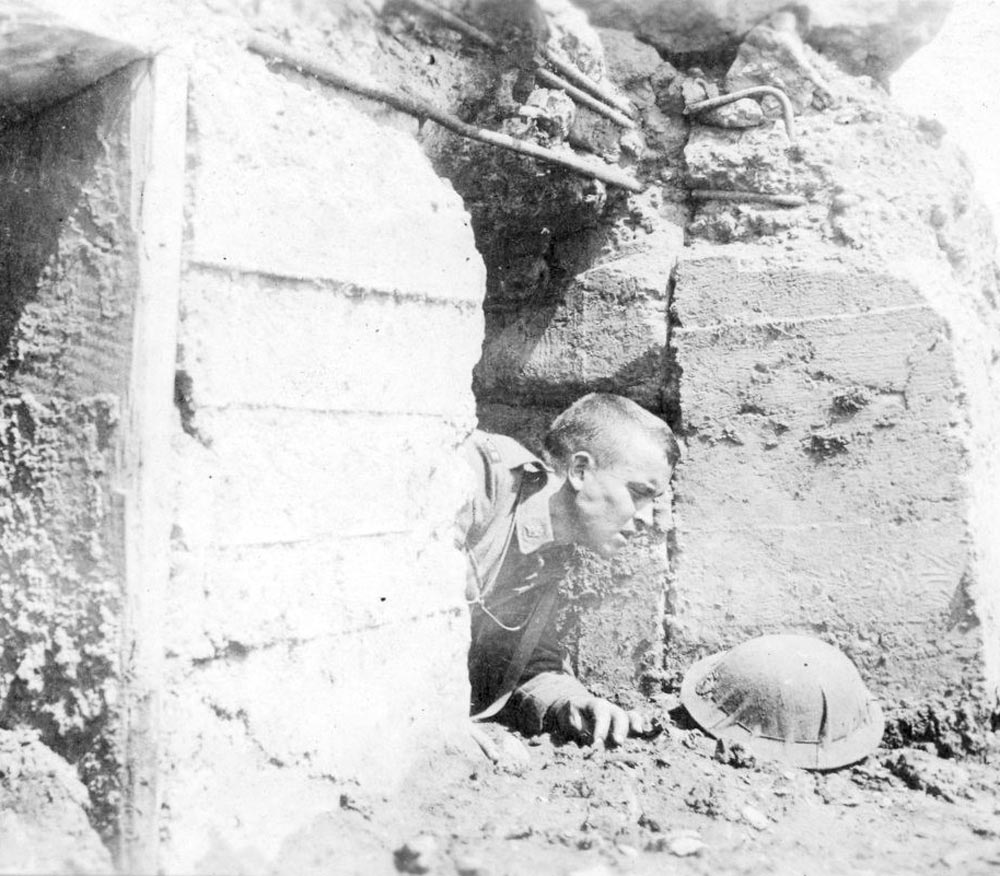
Unknown Canadian soldier in the trenches, 1918.
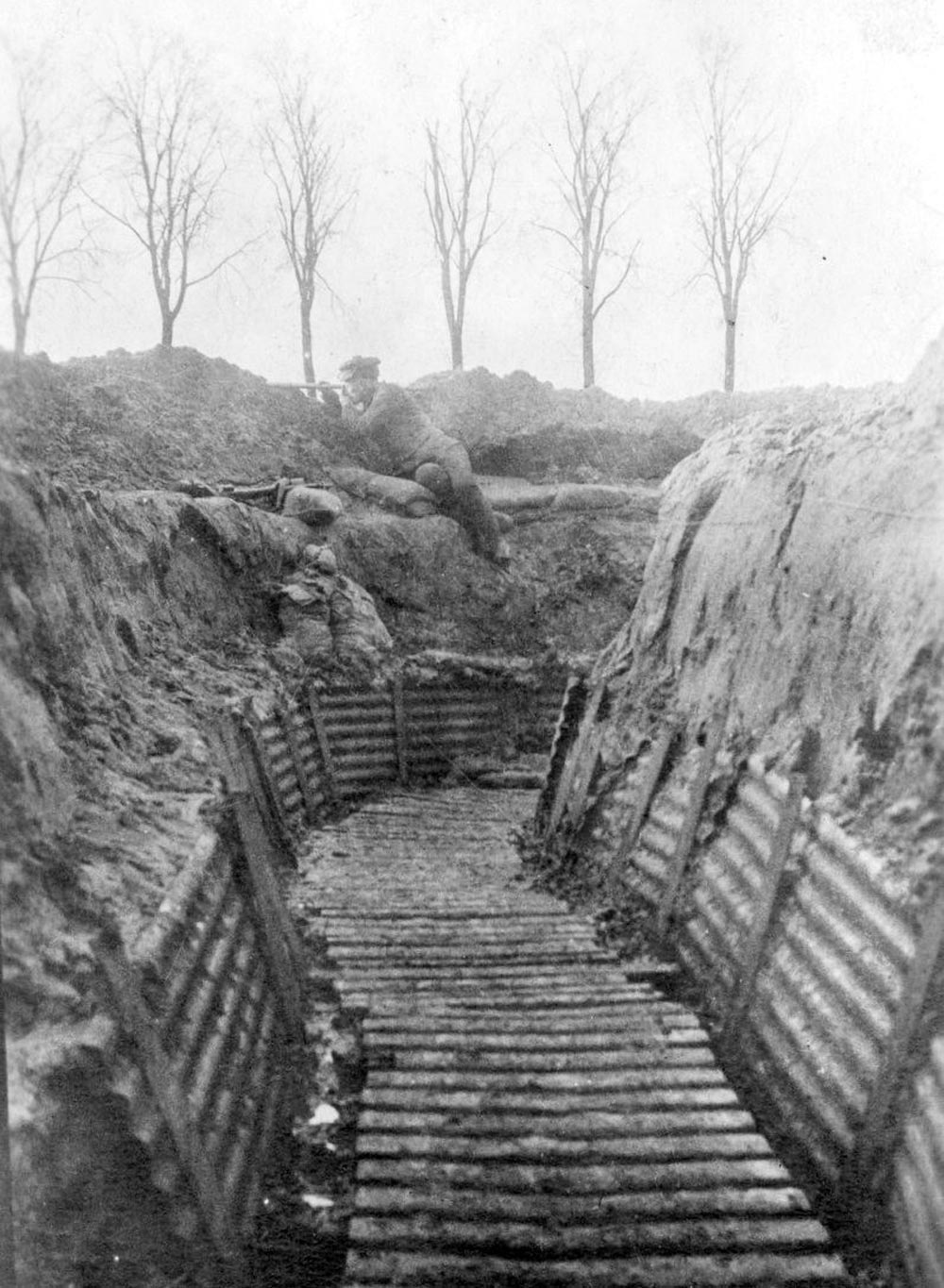
Unknown Canadian soldiers in the trenches, 1918.
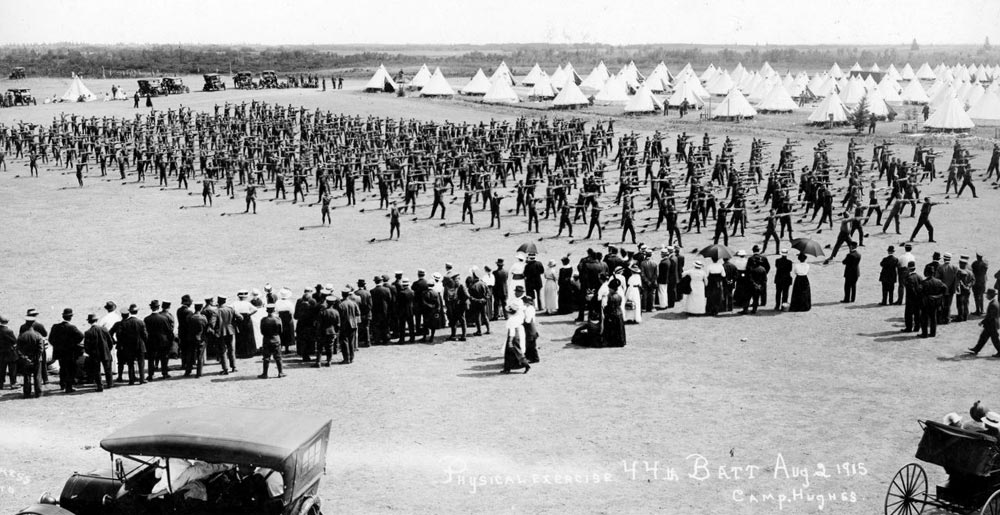
The 44th Battalion at Camp Hughes in August 1915.
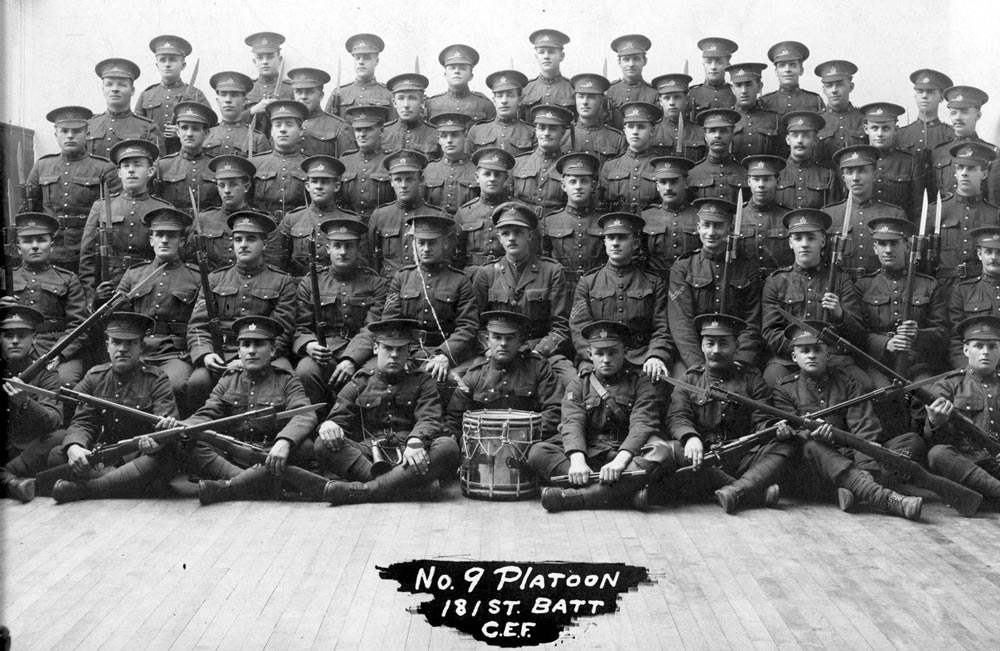
Platoon 9 from the 181st Battalion, CEF, 1916.