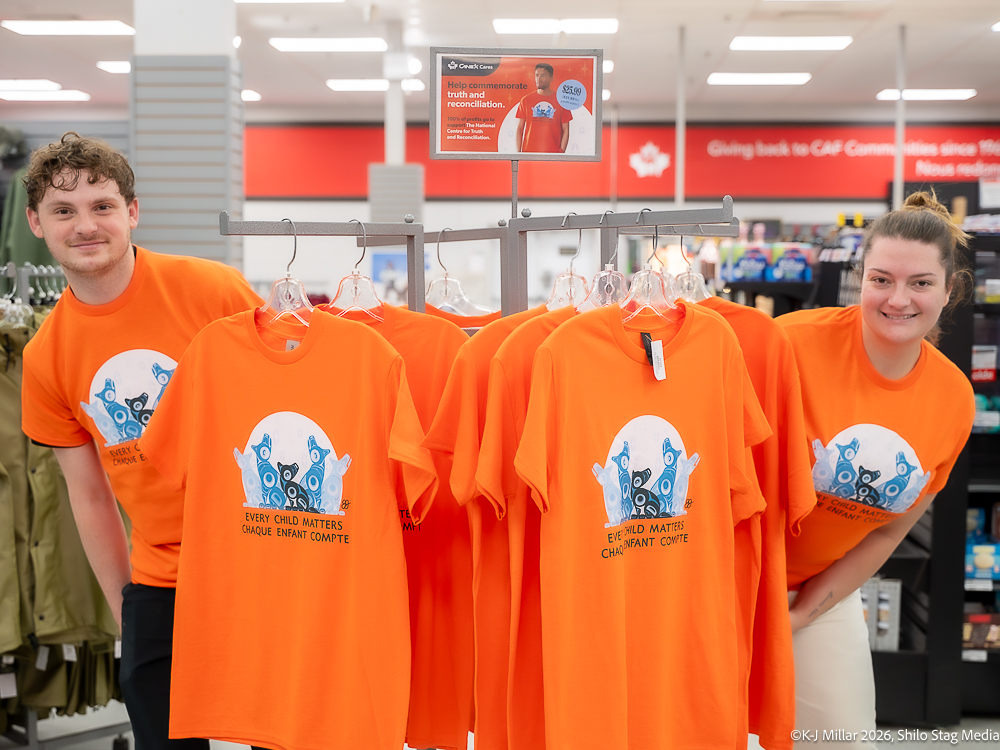
More than 150,000 children were affected by attendance at the Indian Residential Schools (IRS) in Canada for more than 150 years. Many never returned to their homes and families. The last federal Indian Residential School didn’t close until the mid 1990’s. This is not a “historic” situation, but a present-day remembrance.
September 30 is National Day for Truth and Reconciliation. The nation reflects on the dark days and the trauma survivors of the IRS battle with every day. Ceremonies and commemorations take place across the country. In
Brandon, commemorative activities will take place at the Riverbank Discovery Centre from Sept. 28 to Oct. 3.
On Oct. 1, CFB Shilo will recognize the day with a South Gate flag raising at 1 p.m. Civilian staff and military personnel are encouraged to wear an orange shirt in support of the day. Canadian Armed Forces members may show their participation by adding an orange T-shirt, badge, hat, or orange square to their operational uniforms.
This year, 2026, is the sixth nationally recognized day to honour and remember the Aboriginal children who, for more than a century, were separated from their families. Children were placed in 139 schools in every province with the purpose of “a systematic, government-sponsored attempt to destroy Aboriginal cultures and languages and to assimilate Aboriginal peoples so that they no longer existed as distinct peoples.” The Truth and Reconciliation Commission characterized this intent as “cultural genocide,” the
National Centre for Truth and Reconciliation states on its website.
Most schools ceased operating by the mid-1970s. However, the last federally run Indian Residential School did not close until the mid-1990s, the Government of Canada states on its website page
Timeline – Indian Residential Schools.
The first Indian Residential School was opened in 1831 and was a church-run facility. By the 1880s, the federal government had implemented an official policy of funding residential schools across the country.
“The explicit intent was to separate these children from their families and cultures. In 1920, the Indian Act made attendance at Indian Residential Schools compulsory for Treaty-status children between the ages of 7 and 15,” NCTR states.
Many schools were underfunded and overcrowded, with substandard education. Children were punished for speaking their own languages, and staff were not held accountable for how they treated students.
“We know that thousands of students suffered physical and sexual abuse at residential schools. All suffered from loneliness and a longing to be home with their families.
The schools hurt the children. The schools also hurt their families and their communities. Children were deprived of healthy examples of love and respect. The distinct cultures, traditions, languages, and knowledge systems of First Nations, Inuit and Métis peoples were eroded by forced assimilation.”
“The damages inflicted by Residential Schools continue to this day.”
“For a great many Survivors, talking about their experiences in residential schools means reliving the traumas they experienced. For years, many told no one about what they had endured.
In 1996, the landmark Royal Commission on Aboriginal Peoples drew attention to the lasting harm that was done by the residential schools. A growing number of Survivors and their descendants came forward to tell their stories and demand action,” the National Centre for Truth and Reconciliation states.