

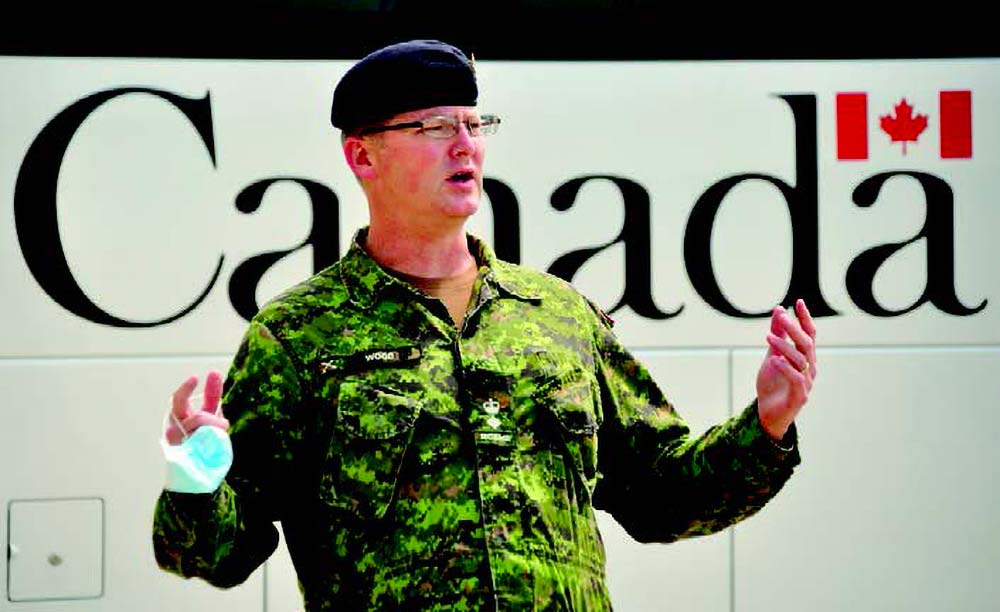
CFB Shilo BComd LCol Chris Wood enjoys leaving his office to visit the units, from promoting soldiers at Base Transport (above) during an outdoor ceremony, to speaking with each DBMQ graduate (below) during their recent Juno Platoon graduation ceremony held at the MPTF. Photos Jules Xavier/Shilo Stag.
Tough completing projects with only two-year term
Jules Xavier
Shilo Stag
It has been an interesting past year for BComd LCol Chris Wood as he navigated a COVID pandemic while overseeing the operation of CFB Shilo.
With 12 months in the books, your Stag editor asked LCol Wood to assess the job he’s done via a Q&A since arriving at the helm of this Base following his posting from Ottawa with wife Lisa, plus son and daughter.
Here are his thoughts and observations on a number of topics he handled from his office located on the first floor at Base HQ.
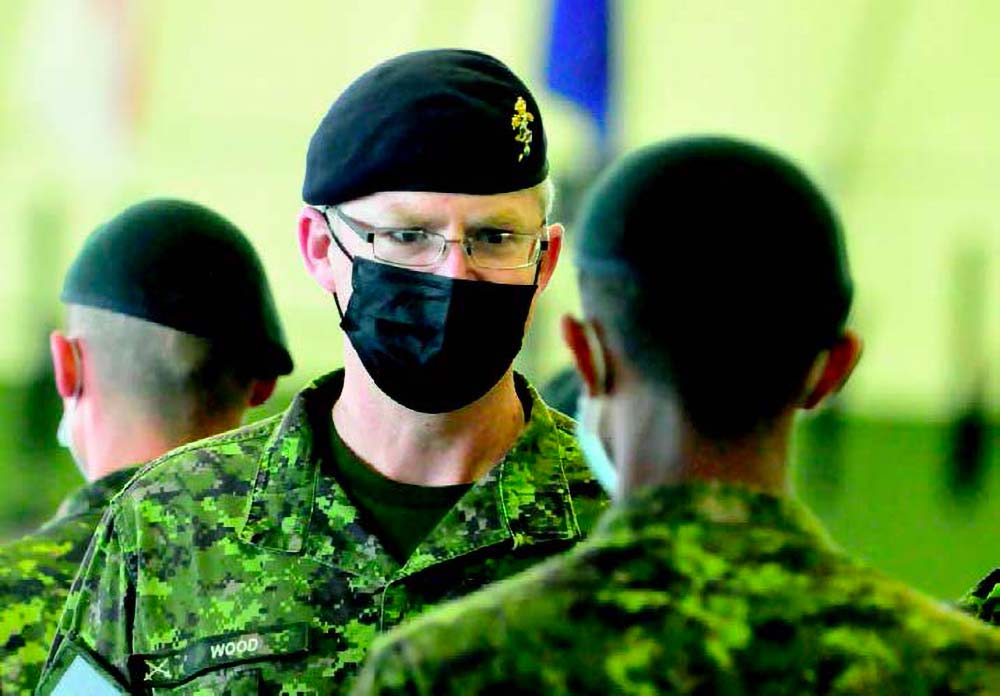
Stag (SS): Looking back on your first year in the BComd’s chair, what’s your assessment on how you did running the Base? If you had to grade yourself, what mark would you give yourself? What about from your bosses in Ottawa or Garrison Edmonton, how have they reacted to the job you are doing?
BComd (CW): “As a self-assessment for my first year I would give myself a ‘P.’ My bosses in Edmonton and elsewhere, as you say, have always been supportive but similarly challenged within their own portfolios.
“Juggling priorities, responding to urgent issues while taking deliberate steps to move boulders; I imagine bigger Bases have bigger problems. The resilience and resourcefulness of our military community of CFB Shilo is impressive, and I believe CFB Shilo has ‘led the way’ on a number of tasks which have not gone unnoticed by our Division’s and Army HQ.
“From last year’s Aid to Domestic wildfire fighting and the Op VECTOR, where over 5,000 vaccines were delivered, to its preparation and deployment of the Enhance Force Presence Force in Latvia, there is no doubt in my mind the soldiers and public servants of CFB Shilo have left their mark on Canadians.”
SS: How has your command team partner like the experienced infantry soldier CWO Jeremy Abrahamse as your BRSM been helping you navigate your job?
CW: “CWO Abrahamse is possibly the most dedicated soldier I’ve ever worked with. He’s a leader with over 30 years of experience, served all over the world with Regular, Reserve and Allied Forces.
“Coming to CFB Shilo from NDHQ in Ottawa, I believe I thread together strategic and tactical initiative completed by Mr Abrahamse’s outstanding insight into the motivations, tendencies and morale of our defence team.
“Really, I’m privileged and quite impressed with the results of the Base leadership selection process. With the two major units on Base being 1RCHA and 2VP, I’ve been lucky to have as partner an extremely experienced BRSM intimately familiar with the 2VP, and a Base COS who was Acting CO of 1RCHA during significant domestic operations.”
SS: Having to work during a pandemic, what was your approach when it came to keeping those who live and work on this Base safe from COVID-19?
CW: “Well, in regards to living and working with the pandemic, I’ve felt it’s important to balance an early shaping of the solution space, sharing messages consistently and minimizing the ‘grey area’ as opposed to allowing that area to expand, and relying on the advice experts.
“In weighing decisions, I have leverage great tools from DND training such as Bid Evaluation Techniques and Addressing Bias. It does seem to instigate a few arguments with one’s self, but I trust the process leads to a better solution.
“Ultimately, I tried to communicate the facts as I know them, reinforce the basics as advised by our medical professionals; empathize and be patient with folks that need some relief, but be firm in regards to expectations.”
SS: What were your priorities as BComd, during a pandemic, to keep the Base running and people safe?
CW: “My priorities for CFB Shilo have been one: Support to Operations and Training’ two: Focussing on Total Wellness, and three: Engagement with Partners. CFB Shilo and our higher HQ, namely 3CDSG, have tried to be more conservative in our approach to business with the aim of ensuring the provision of a basic level of support, and thereby allowing our peers in the major units on Base to assume more risk.
“This manifested itself in January 2022, for instance, when many Base sections worked in separate shifts to minimize the chance a COVID outbreak could necessitate shutting down any particular service. I think this approach did build up a bit more backlog in work and cause some frustration with some folks that were pushing hard to complete all their activities prior to deployment, but I believe it ensured access to needed support for Ops and Training while balancing any health risks to our Base team.
“Despite much and ongoing discussions about ‘working from home,’ for example, every employee I encountered was motivated to get the business of the Base done whether it was from the ‘office/warehouse/workshop/kitchen’ or from elsewhere.
“Ultimately, operating in this enduring pandemic has required us to work to and trust the limits of our respective sections. While I expect that sections felt near constant pressure, I think they felt empowered as well.”
SS: How do you think your plans for the Base and its population worked out after more than two years locked down, working virtually and wearing masks indoors?
CW: “I have been extremely proud of the military community’s responds during COVID. Contrary to the phrase — ‘two-years locked down,’ offices and individuals have found a way to make ‘it’ work, and in the majority of cases, that has been by returning to a modified office environment.
“Many offices did not shut down, though access to services were ‘scheduled’ versus ‘walkin,’ and I previously mentioned the use of ‘shift work’ or ‘mini-cohorts’ to ensure the provision of support.
“I know there have been discussions and frustration over the different versions of ‘return to work’ across the country and across government, but I have been wholly impressed with the trust employees and military members have had in each other, to remain considerate and not comprise one-another’s health.”
SS: What were military members and families asking of you as BComd when it came to pandemic survival?
CW: “Honestly, I don’t think I’ve had that many questions on the matter. Certainly there has been frustration expressed in regards to differences between provincial health constraints and federal health constraints, and the continued wearing of masks while indoors at DND establishments is such an example.
“But I think the CAF has and continues to address the pandemic with the seriousness needed so that we ensure the Force remains fit to be called upon as needed. I think this firm and consistent approach is respected by our military community members, families and other civilian counterparts.”
SS: What have you learned about yourself as an individual when it comes to your responsibilities running a prairie Army Base?
CW: “I suppose my biggest take-away is that my great ideas from before I took over as Base Commander aren’t as great of an idea now that I better understand the local and regional dynamics.
“I question where and whether I could have better appreciated these aspects before I arrived, and I do think there are some ‘system’s engineering’ techniques I could have made better use of. That and perhaps listening to my wife.”
SS: What are some of the challenges facing you going into your second year at the helm as BComd? What is your approach when it comes to handling challenges?
CW: “Get things down. How to confirm and keep the pulse of the community; now that a relationship has been built, how to do something with it.
“DND has motivated, experienced and smart people working in it, and we take work seriously. With the amount of work to do in the Army, despite knowing our current team will be able to figure out the next big problems around the corner, my approach is assist in managing the pace of work and the challenges.
“I want to be involved, to set the pace tackling problems, to navigate where appropriate, [and] share lessons learned and then reset.”
SS: Who have you tapped into to help navigate the role of a BComd, and the nuances which come with the position — there’s no Base Commander School where you learn how to do the job?
CW: “Great question! I’ve leveraged peers, historical examples and my current and former bosses — there are always examples of what worked well for others in somewhat similar situations, and what outcomes one would want to avoid.
“True there is no Base Commander School, but I feel I’ve been able to leverage some knowledge or experience from almost every position I held up to this point.
“As a bit of an antidote and prophesy into the job, I attended the Army Command Team course — a pre-request for a Command opportunity in the Army — in February 2021. The course opened up with an address from our Army Commander, after which he took some direct questions from some confident candidates on the course.
“Forty-eight hours later Gen Eyre was the Acting CDS and I recall thinking we had received our Unit Command expectations directly from the CDS himself – I knew exactly what had to be done. All I had to do was figure out how to do it.”
SS: What are some of your highlights from your first year?
CW: “I found the year has flown by. Some of the highlights include meeting so many folks doing great work; being able to help some folks out of a tough spot during moving season; seeing employees trust each other and coming back into the workplace; enabling soldiers to get out and help fight wildfires, floods or keep the mountain passes open; attending the Royal Manitoba Winter Fair; and seeing off our various waves of soldiers on their way East.”
SS: What’s it like being part of promotion ceremonies as BComd and seeing the smiles — behind the masks — on your military members standing before you?
CW: “Promotions are such a privilege – I get to call members into the spotlight and remind them they’ve earned this recognition, and try to emphasize their new authority and expectations.
“I’m not sure folks are always smiling behind their masks … the promotees usually appear a little nervous, but my getting to have a little chat with them, getting their spouses and kids involved is fun.
“Before they march away wearing their new rank I do try to crack a ‘Dad’ joke and draw out a smile. It doesn’t always work, but my kids say my jokes really aren’t funny.”
SS: With projects like moving the ammo dump across the road to the RTA, or trying to have the CAF replace the current Base kitchen — versus continually putting bandaids on it — what is your approach from your office to have these projects come to fruition. How do you sell the idea these projects are important for CFB Shilo looking to the future?
CW: “There are two main approaches I’ve tried to take in regards to these issues. The first is to emphasize the impact to CFB Shilo’s customers, and to articulate where they could lend their support to these projects.
“My belief in this regard is that one may articulate the value they bring to the table, but that value-proposition is multiplied exponentially when others at the table concur or further enforce it. The second approach is to use of the full extent of the authorities vested in the local leadership team.
“By this I refer to developing and pursuing creative options that necessitate the acceptance of some risk, but which is undertaken with a clear understanding of authority limits. I can’t say that all challenges can be addressed in my two years, but I do see many complex initiatives that can be progressed.”
SS: Have there been any disappoints doing your job as BComd?
CW:“Tough question to answer. The end of the pandemic did not occur. Russia was not dissuaded from invading Ukraine. The Canadian economy is tenuous these days and as the largest Federal Government department, DND and the CAF is focusing on this core tasks, that is, ‘doing less with less.’ During my time as Base Commander, as I imagine was the case with my predecessors, I question where I could be making more of a difference … where is President Putin’s phone number?”
SS: What have your enjoyed about working/living in Manitoba after being posted west from Ottawa?
CW: “I love the opportunity with the military to discover new parts of the country. Manitoba is a province rich in history and much untapped potential. It’s home to the geographic center of Canada; has a port ‘city’ of 900 people on Hudson Bay, and seems to have the biggest [well-fed] dragon flies in the country.
“As compared to where we were living in Ottawa, I appreciate the reduced level of traffic, and I like the close community that is the Base — i.e. Base barbecues, hearing the firing of guns or ordnance dropping, seeing troops deploy.”
SS: What goals have you set for yourself in the second half of your tenure as BComd?
CW: “First year was about understanding the regional dynamics, setting priorities and moving forward on key initiatives. There is now momentum gained that I look to maintain.
“With the relationships that have been built, I look to get things done. I feel the Base has become close with our dependent units, and I hope to reinforce those successes after the APS [Annual Posting Season] by welcoming and energizing the new crew to make things happen.
As for my goals, I plan to strengthen the relationship amongst the units on Base; increase the involvement of our community members in our community; and bring more business to the Base, be it Reserve training, training with our allies, or range clearance activities.”
SS: When that CoC ceremony happens again for you to relinquish command of the Base in the summer of ‘23, what will you miss about the job when you pack the family up and head to your next CAF posting?
CW: “Tough question, as I am more often consumed by thoughts of what I need to do as opposed to what I miss. But certainly, looking back at our time in Shilo I’ll miss the friends we got to know, I’ll miss seeing kids biking and knowing they were part of my military family; I’ll miss seeing soldiers on course marching with emphasized movements, hearing the activities on the range, free movies at the theatre, and seemingly, my own Canada Day fireworks display.”
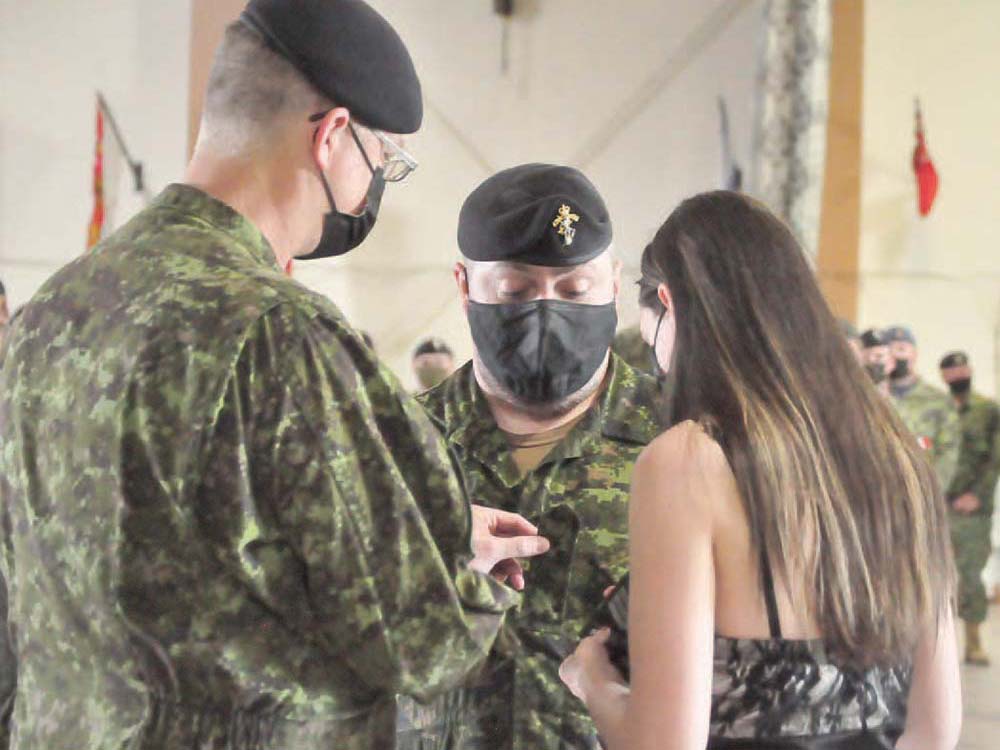
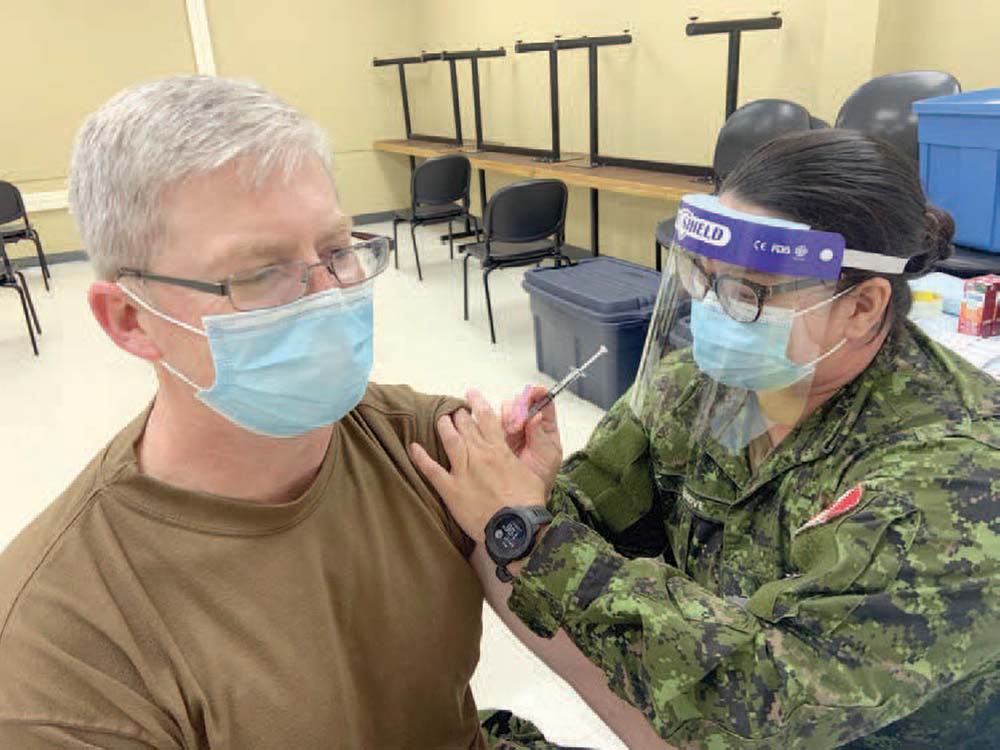
BComd LCol Chris Wood enjoys bringing up family members to help with promotions (left) when he’s not rolling up his sleeve during the pandemic to receive his COVID needle (right) from staff at 11 CF H Svcs C. The COVID-19 pandemic has been one of LCol Wood’s biggest challenges since arriving from Ontario in 2021. Photos Jules Xavier/Shilo Stag.