

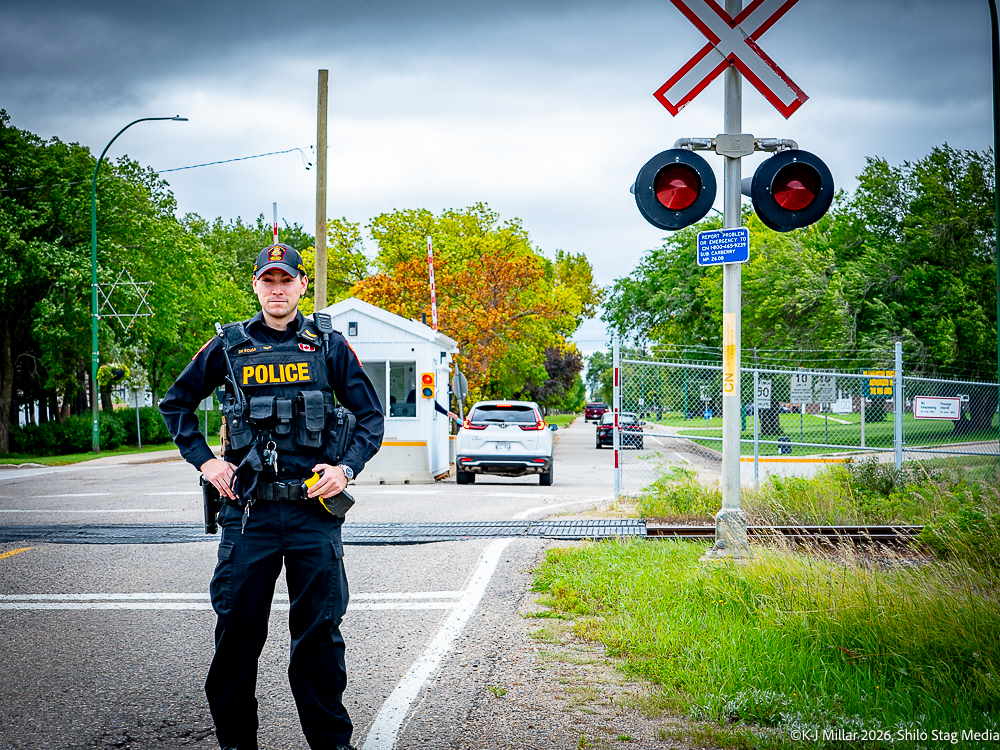
CFB Shilo Military Police are issuing an educational reminder to motorists about the illegality of stopping over railroad tracks. MP Officer Corporal Marc De Sousa stands at the North Gate rail crossing on Sept. 15, where double white lines indicate the safe distance vehicles should stop before and after crossing the tracks. Vehicles should not stop between the two sets of lines. (Photo: K-J Millar/Shilo Stag News)
K-J Millar
Shilo Stag Media
Military Police at CFB Shilo are issuing an educational reminder to drivers on Sept. 15, about railway safety and the proper use of vehicles in train-track areas, such as the North Entrance Gate to the Base.
Police Detachment Commander Sub-Lieutenant Kenneth Chang said some vehicles are not complying with highway traffic rules and are jeopardizing safety by stopping on the train lines into the Base.
He said officers issued nine general traffic violations in August on CFB Shilo and wants to use the opportunity to share knowledge with motorists driving around the Base.
“Under the Manitoba Highway Traffic Act, motorists must not stop a vehicle within a railway crossing or in a position where any part of the vehicle is over the railway tracks,” he said.
According to the Manitoba Highway Traffic Amendment Act S.M. 2004 c. 30, s. 134, various subsections clearly state the laws.
“It is important to remember not to stop or idle a vehicle on railway tracks. Ensure no part of the vehicle is resting on the rails,” he told Shilo Stag News.
“Do not enter a crossing if traffic congestion may prevent the vehicle from fully exiting the tracks.”
Required stopping distances before the tracks are indicated in MHTA 2004, s. 134(5), where it states, “ … the driver shall stop the vehicle (a) not less than five meters from the nearest rail of the crossing, if the crossing is in a restricted speed area; or (b) not less than 15 m from the nearest rail of the crossing in any other case.”
The tracks at the North gate are in a restricted speed area.
The detachment commander said that before crossing, drivers must ensure enough space on the opposite side to clear the crossing completely and make sure that no part of the vehicle is over or resting on the rails.
“This reminder may help increase awareness and reduce the risk of vehicles becoming stopped on the tracks,” Sub-Lt. Chang said.
The MHTA legislates several requirements for drivers, including looking both ways along the railway track for an approaching train; listening for signals indicating a train’s approach; and, if the vehicle is a bus or school bus, opening the vehicle door.
The legislation also states it is illegal to change gears while crossing the tracks.
“The driver of a vehicle … shall not (a) cross the track of a railway crossing in a gear that he or she will need to change while crossing the track; or (b) change gears while crossing the track,” the Act reads.
The railway crossing at the North gate is in a controlled railway crossing area with sound and light signals. For this situation, the MHTA 2004, s. 134(2) states:
“The driver of a vehicle approaching a railway crossing shall stop the vehicle before proceeding across the crossing if (a) a “stop” or “arrêt” sign is erected at the crossing; (b) a clearly visible electrical or mechanical traffic control device at the crossing is signalling the proximity or passing of a railway train; (c) a crossing gate is lowered or partly lowered, or a flag person is signalling the proximity or passing of a railway train; or (d) a railway train is in dangerous proximity to the crossing and is giving an audible signal or is visible.”
The Act also clarifies that “a driver who stops at a railway crossing because an electrical or mechanical traffic control device is signalling the proximity of a railway train may proceed across the crossing if the train is stopped, or is not in close proximity to the crossing, and if he or she can do so safely and without stopping before clearing the crossing.”
Sub-Lt. Chang encourages all motorists to respect traffic regulations while on the Base.
“Please slow down and exercise caution when approaching crosswalks, school zones, and other areas with increased pedestrian activity. Safe driving is a shared responsibility, and a moment of attention can prevent a serious incident.”
For a comprehensive read of the law about railway crossings, visit: https://web2.gov.mb.ca/