
Jules Xavier
Shilo Stag
Who was PPCLI soldier Sgt George Mullin?
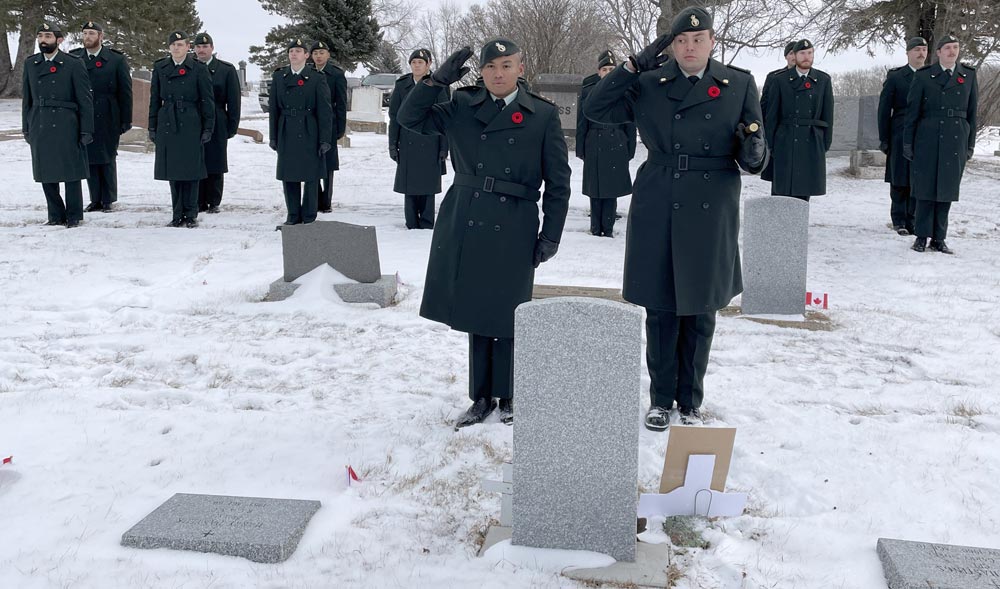
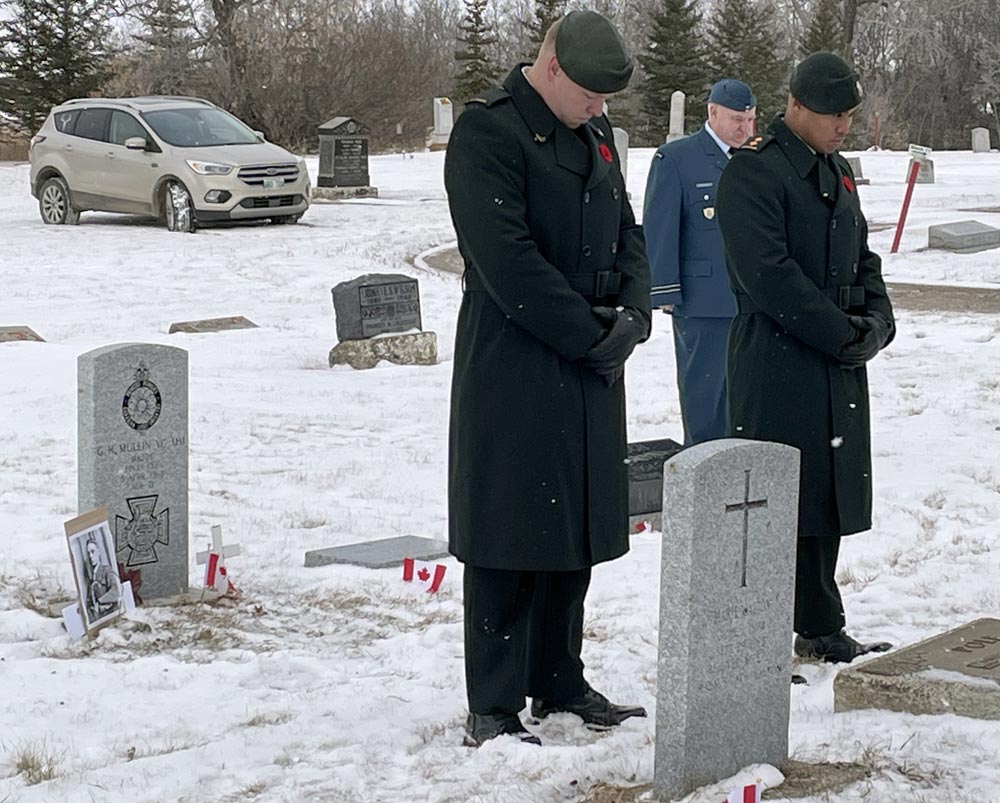
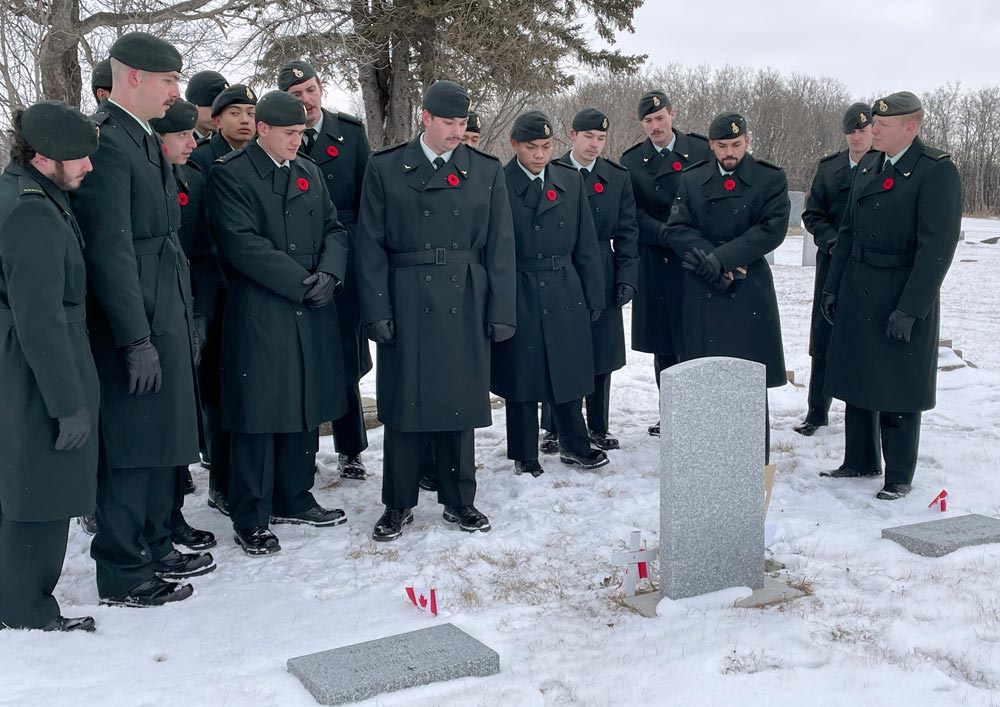
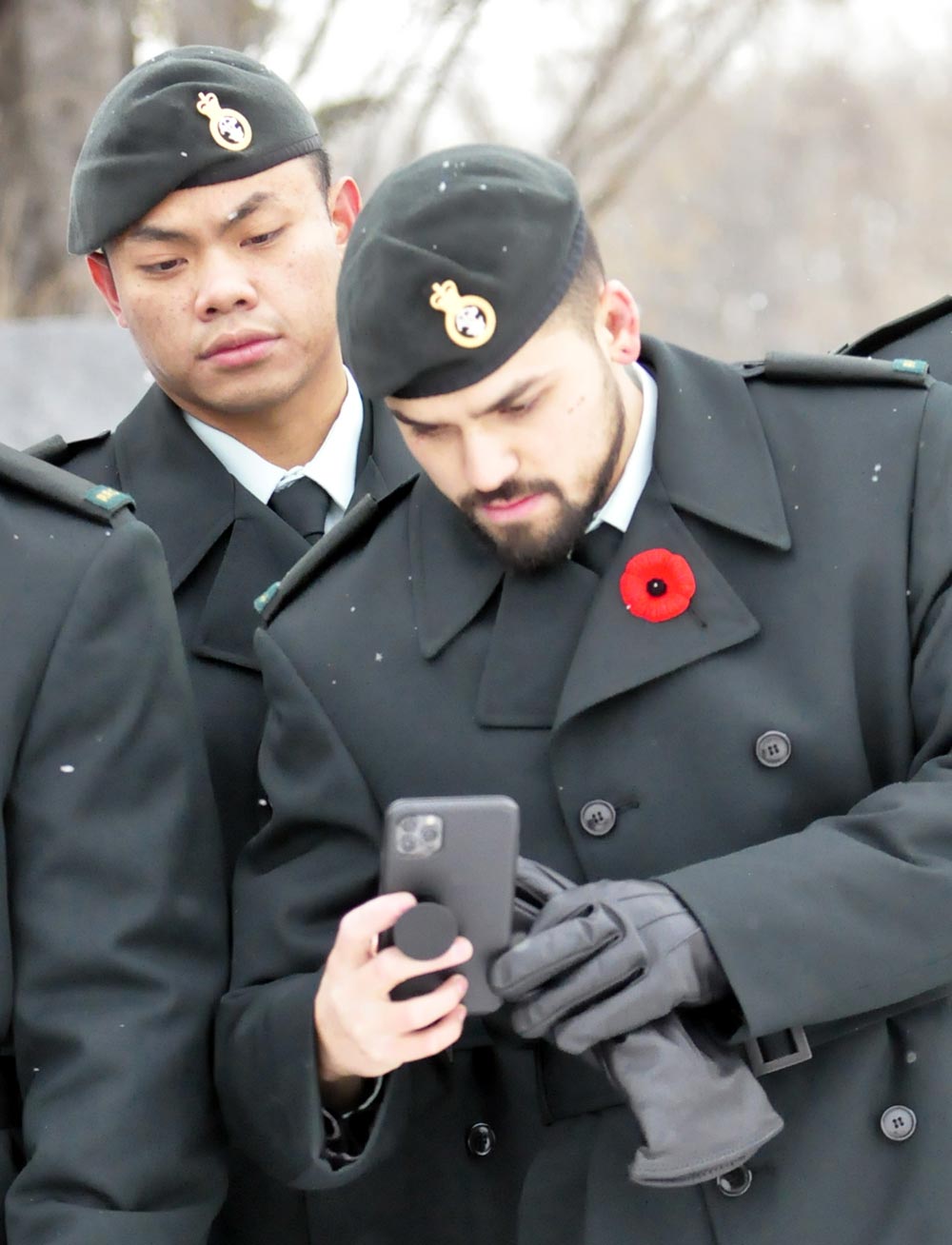
2PPCLI soldiers visiting a Moosomin, SK, cemetery Nov. 11 learned about the Victoria Cross (VC) recipient from the Great War at his grave. B Coy Cpl Mackenzie Shambrook provided his comrades with the back story while they stood solemnly in a foot of snow, light flurries falling from the overcast sky.
Sgt George Mullin is not forgotten from PPCLI’s history, and fellow Patricias annually lay a wreath and raise a rum toast to their comrade.
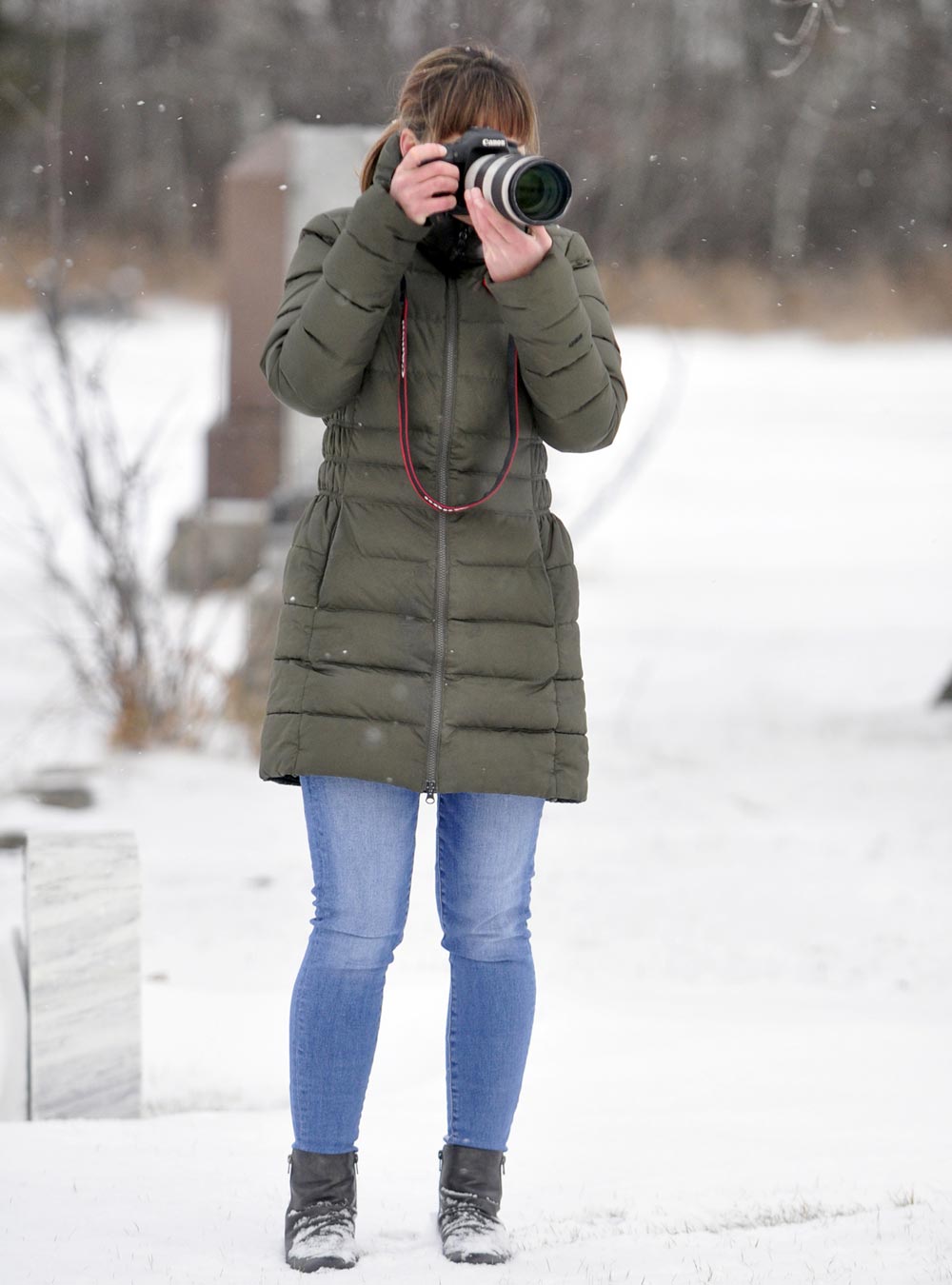
Your Shilo Stag was there, too, observing nearby in the south cemetery. Local media also covered the ceremony for the first time, with The World Spectator associate publisher Kara Kinna focused on the event, one of her photos making front page for the Nov. 14 edition.
“We’ve never covered this [on Remembrance Day] in the past,” she said before speaking with B Coy 4 Pl Comd Lt John-Tolfin Pallasigui and Admin Coy transport Sgt Alex Helbren following the arrival of 2PPCLI’s bus from CFB Shilo.
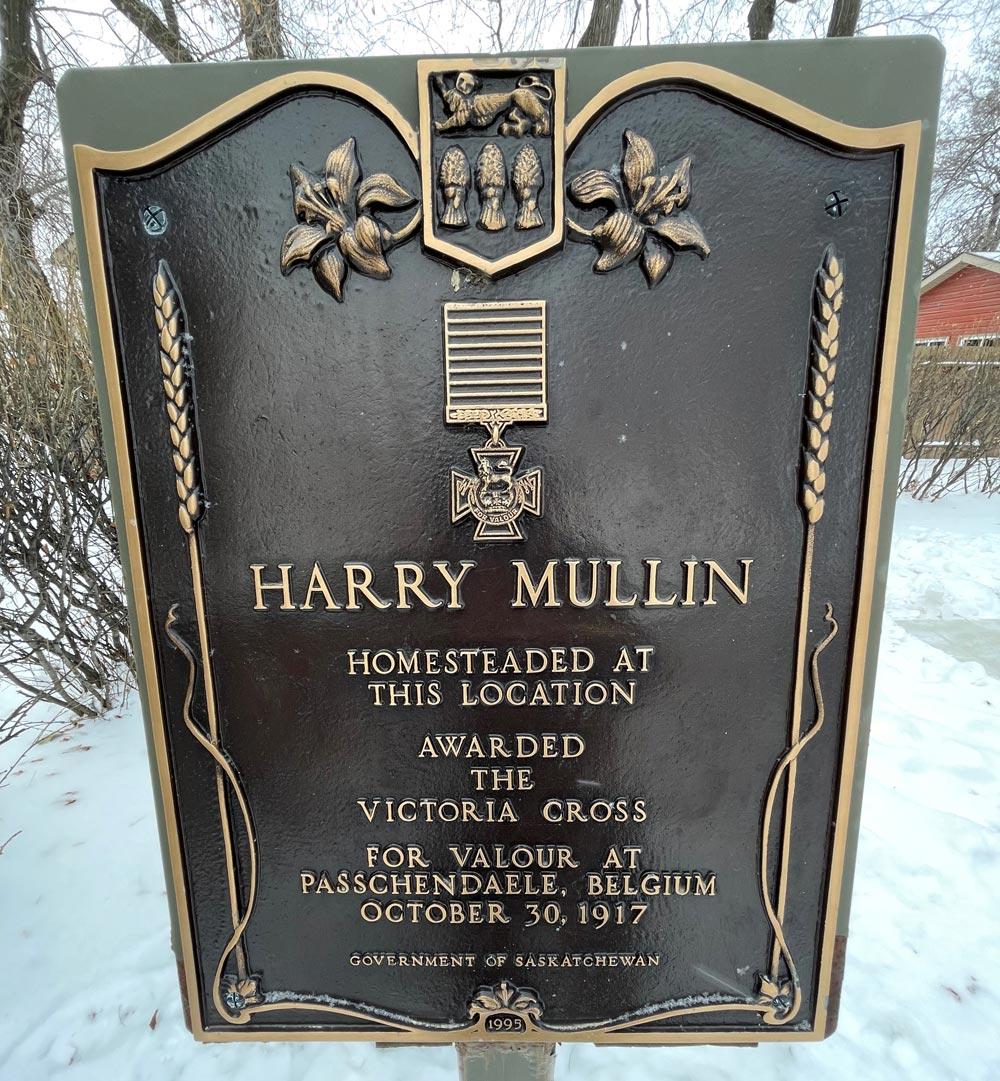
This scribe again thought about 26-year-old Sgt Mullin’s heroic actions on the battlefield on Oct. 30, 1917 near Passchendaele in Belgium which led to his VC.
The citation written in the London Gazette on Jan. 11, 1918 explained why he received a VC.
It read, “For most conspicuous bravery in attack, when single-handed he captured a commanding ‘Pillbox’ which had withstood the heavy bombardment and was causing heavy casualties to our forces and holding up the attack. He rushed a sniper’s post in front, destroyed the garrison with bombs, and, crawling on to the top of the ‘Pillbox,’ he shot the two machine-gunners with his revolver. Sgt Mullin then rushed to another entrance and compelled the garrison of 10 to surrender. His gallantry and fearlessness were witnessed by many, and, although rapid fire was directed upon him, and his clothes riddled by bullets, he never faltered in his purpose and he not only helped to save the situation, but also indirectly saved many lives.”
The Victoria Cross is the highest award for gallantry in the face of the enemy which can be awarded to British and Commonwealth forces.
Besides Sgt Mullin, Moosomin has the distinction of having two Great War soldiers and one from the Second World War who are VC recipients. Unfortunately, the other two received their medals posthumously.
A farmer in Moosomin’s hinterland at Wapella, Company Sergeant Major (CSM) John Osborn received his VC for sacrificing his own life for that of his comrades. It was Dec. 19, 1941 in the British Colony of Hong, with Osborn part of the Winnipeg Grenadiers. He was facing attack from the Japanese invaders on a steep rising hill on Mount Butler.
His group had captured the hill at the point of the bayonet, and held it for three hours, before withdrawing under heavy fire from a Japanese counter-attack. With a few of his comrades, he covered the withdrawl single-handedly. Surrounded by the enemy, his company was cut off from the battalion. Tossing grenades at the Canadian soldiers, Osborn was able to throw them back. However, one of these grenades fell in an area where he was unable to throw back — instead, shouting a warning to his comrades, he threw himself on the live grenade, which exploded, killing him instantly.
Lt Robert Combe received his VC after his battalion was ordered to occupy German trenches near the town Acheville, France on May 3, 1917. The Germans expected the attack, and by the time Combe and his men reached a point 500 yards from the German lines, he was the only officer in his company still alive.
Caught in artillery cross-fire from German guns and their own guns, Lt Combe and six of his surviving comrades, attacked the enemy position, capturing 250 yards of trench and 80 prisoners. The 37-year-old was fatally wounded by a sniper’s bullet in the final charge.
Born in Portland, Oregon, on Aug. 15, 1891 — Sgt Mullin grew up in Moosomin after his parents left the USA for Saskatchewan. He enlisted in the army in December 1914. With the Princess Patricia’s Canadian Light Infantry (PPCLI), Canadian Expeditionary Force (CEF) during the First World War he served as a scout and sniper.
He had already received the Military Medal (MM) for his conduct on the occasion of a successful attack by the Canadian Corps during the Battle of Vimy Ridge in April 1917.
In 1934, he was appointed as Sergeant at Arms of the Saskatchewan legislature. He also served as a captain in the Veterans Guard during the Second World War.
His Victoria Cross is displayed at the Museum of the Regiments in Calgary. He was 71 when he died on April 5, 1963.
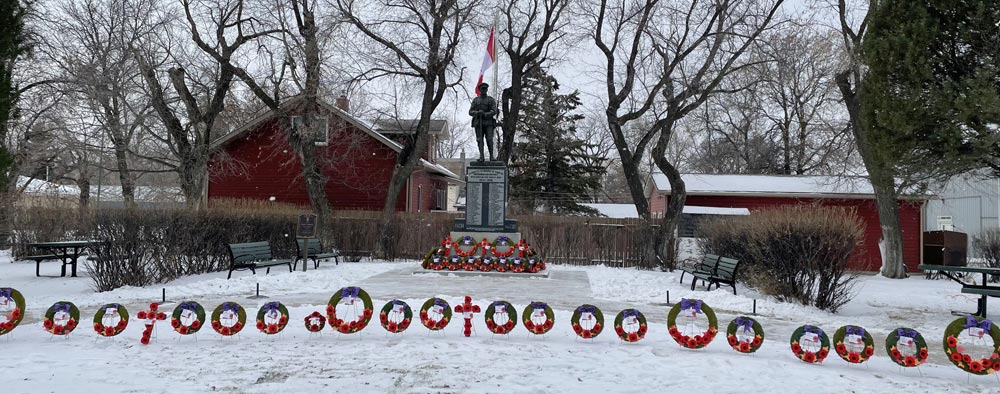
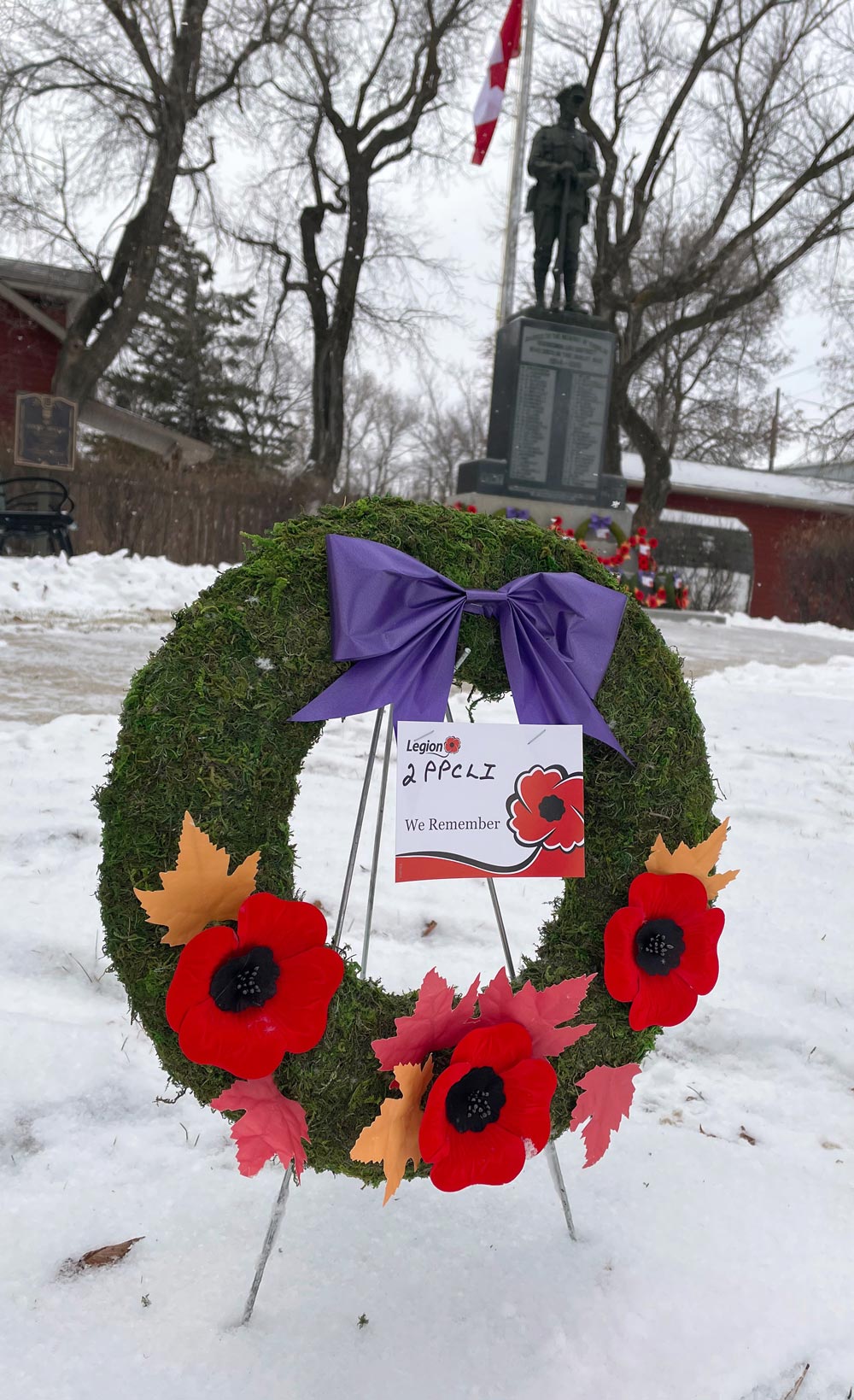
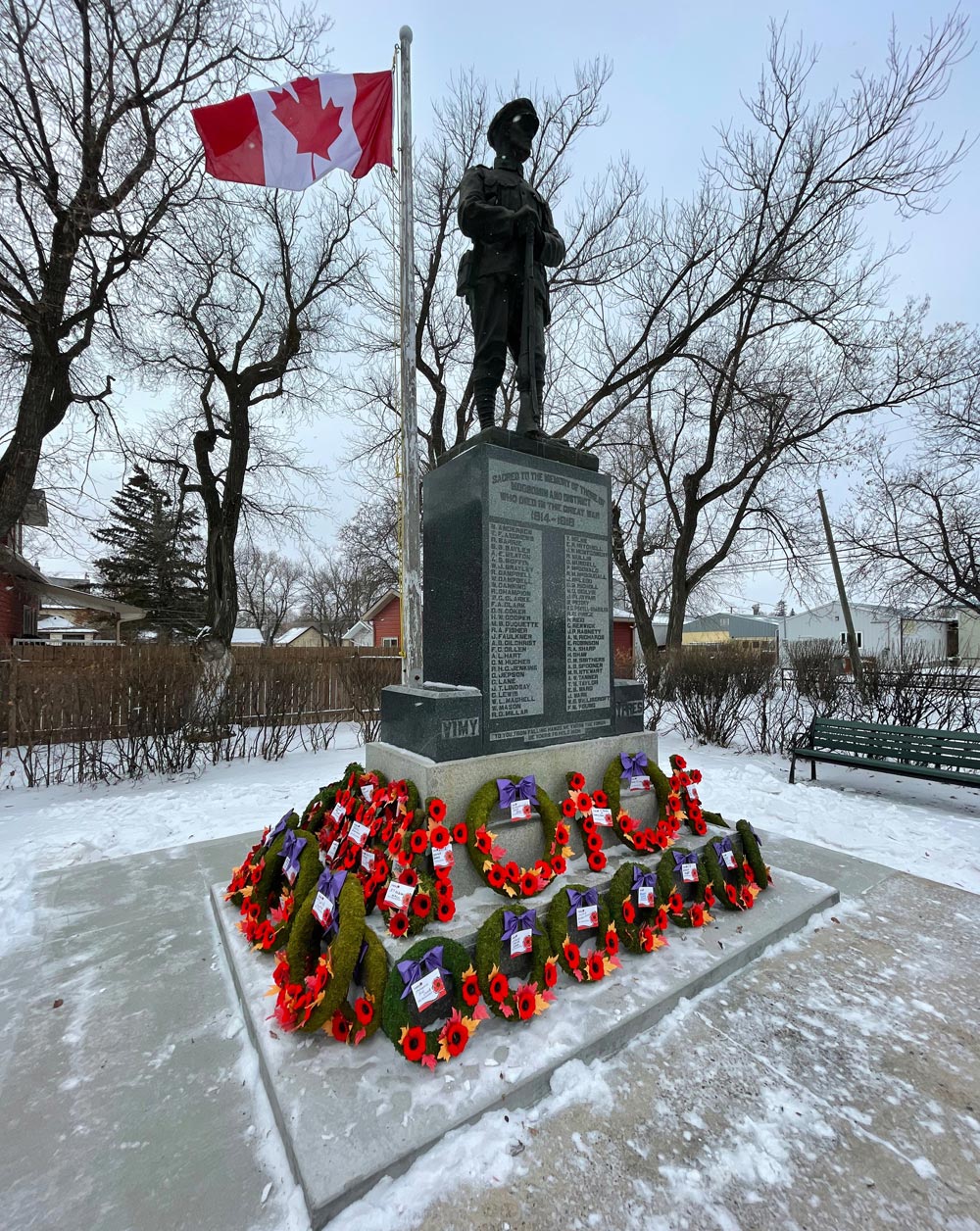
Following the gravesite ceremony, 2PPCLI attended an indoor Remembrance Day ceremony at the Moosomin Legion, then moved outdoors to the nearby Great War cenotaph where numerous wreaths were laid at the foot of a First World War soldier standing high above as he looked north. 2PPCLI annually sends soldiers for a gravesite ceremony for Sgt Mullin Nov. 11.
A lot has changed since Sgt Mullin fought on muddy battlefields in France or Belgium.
Fast forward to the early 2000s, and Canadian soldiers — including 20 who were based here — died under dusty conditions in Afghanistan after fighting Taliban soldiers, or their LAV hitting improvised roadside bombs.
War is a plague on humanity which has existed as long as people have gathered together and will unfortunately and without doubt mar our lives again.
Not a year has gone by in recorded history where at least one civil war, revolution or insurgency has not taken place. It has been said that the one constant in the history of man is war.
No matter how many young men or women perish or how many lives are turned upside down, war persists through time.
When you can, take a walk to the cenotaph in Brandon, Douglas, Souris, Boissevain or other Manitoba hamlets, towns and cities and try to picture the faces of those who never returned home after losing their lives on a far off battlefield. The names are engraved on those stones.
Like the three Bowes brothers who died in the Great War (1914 – 1918), and are among 59 names inscribed on a towering cenotaph unveiled in 1920 in Boissevain which features an Italian carved statue of a soldier.
The community of Glenboro saw 34 men and women lose their lives in the Great War, including nursing sister Christine Frederickson, who died on Oct. 28, 1918, and 13 in the Second World War (1939-1945), including F/O T. Frederickson.
There is a community north of Edmonton, the hamlet of Vimy — named after Vimy Ridge in France where 11,285 Canadian soldiers perished during the First World War. Of this total, there were eight men from Boissevain who died at the Battle of Vimy Ridge in 1917, including Hank Anderson and buddy Gordon Little from the 44th Battalion. These two as well as Cliff Mains are profiled in a locally produced documentary Warpaths: Every Town Had A Soldier.
We keep reminders such as a cenotaph close to our communities and in sight to remind us of the folly of war. Cities, towns and villages list their fallen on the cenotaph, with some of those soldiers who died on the Vimy battlefield having trained in trench warfare in 1916 at nearby Camp Hughes as part of the Canadian Expeditionary Force.
Like Kendra Minary’s great-great-uncle Pte Cecil Minary, who trained at Camp Hughes before going overseas. The Souris resident shared his story with the Stag after researching his CEF career during the COVID pandemic, which was cut short when the Lewis Gunner was KIA on Aug. 28, 1918 after his unit was hit by German artillery.
There are 11 soldiers buried at Camp Hughes, but their deaths were attributed to disease during training. Pneumonia was especially cruel to young soldiers, with seven dying, including four privates who died in a 13-day span in July 1916: John Davidson (13th), John Messenger (17th), Walter Barringer (22nd) and William Perkins 26th).
In the Brandon cemetery, two buddies with the Canadian Mounted Rifles died in the spring of 1915 while training to go overseas with the CEF. They are buried together, with a family grave stone, plus their military tombstones which came later. Trooper John Bloomer, 28, went first on March 3, while Cpl Thomas Lane followed on April 2. He was 21.
The First World War was labeled as the War to End All Wars, but perhaps a more fitting name would be the war to herald a new age of warfare. Poison gas, tanks and machine guns all evolved from the bloody trenches of that era.
Now more than ever before, with the destructive forces at our command, the message behind Remembrance Day rings true; war is mankind’s greatest and deadliest folly.
Walk through the Brandon cemetery and its military section and gaze at granite slabs above veterans who survived the conflict overseas so Canadians could enjoy their freedoms. Among the many rows is one for 2PPCLI’s MCpl Timothy James Wilson, who was KIA on March 5, 2006 while in Afghanistan with 2PPCLI.
It has been 104 years since the First World War ended, and 77 since the last shots were fired in the Second World War. Our veteran population from three conflicts, including the Korean War, grow fewer with the passage of time.
Every Nov. 11, Canadians across this country pause in silent moment of remembrance for the men and women who served our country during wartime.
Like Douglas where 13 men from that tiny community died in the First World War and are listed on its cenotaph.
They grow old today, but their actions should not be forgotten, just as their comrades who sacrificed their lives and their future so that we may live in peace, whether in France or Afghanistan.
Lest we forget!
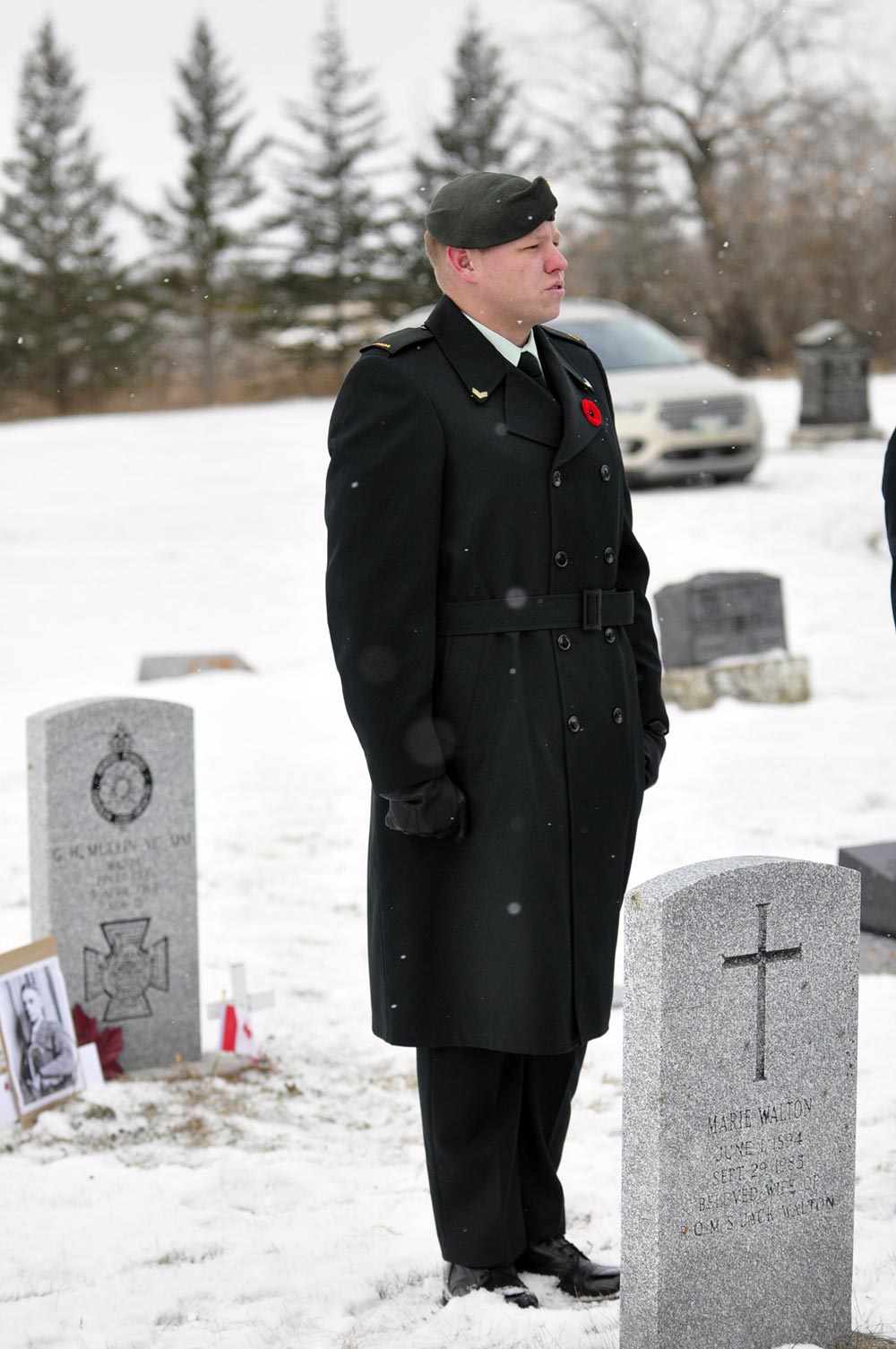
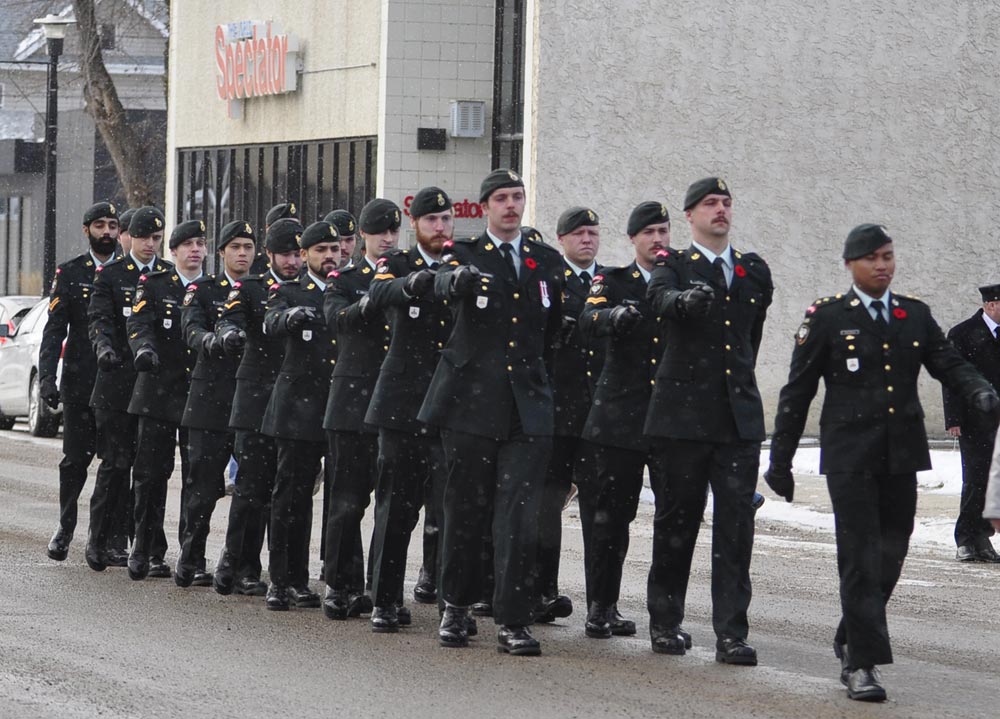
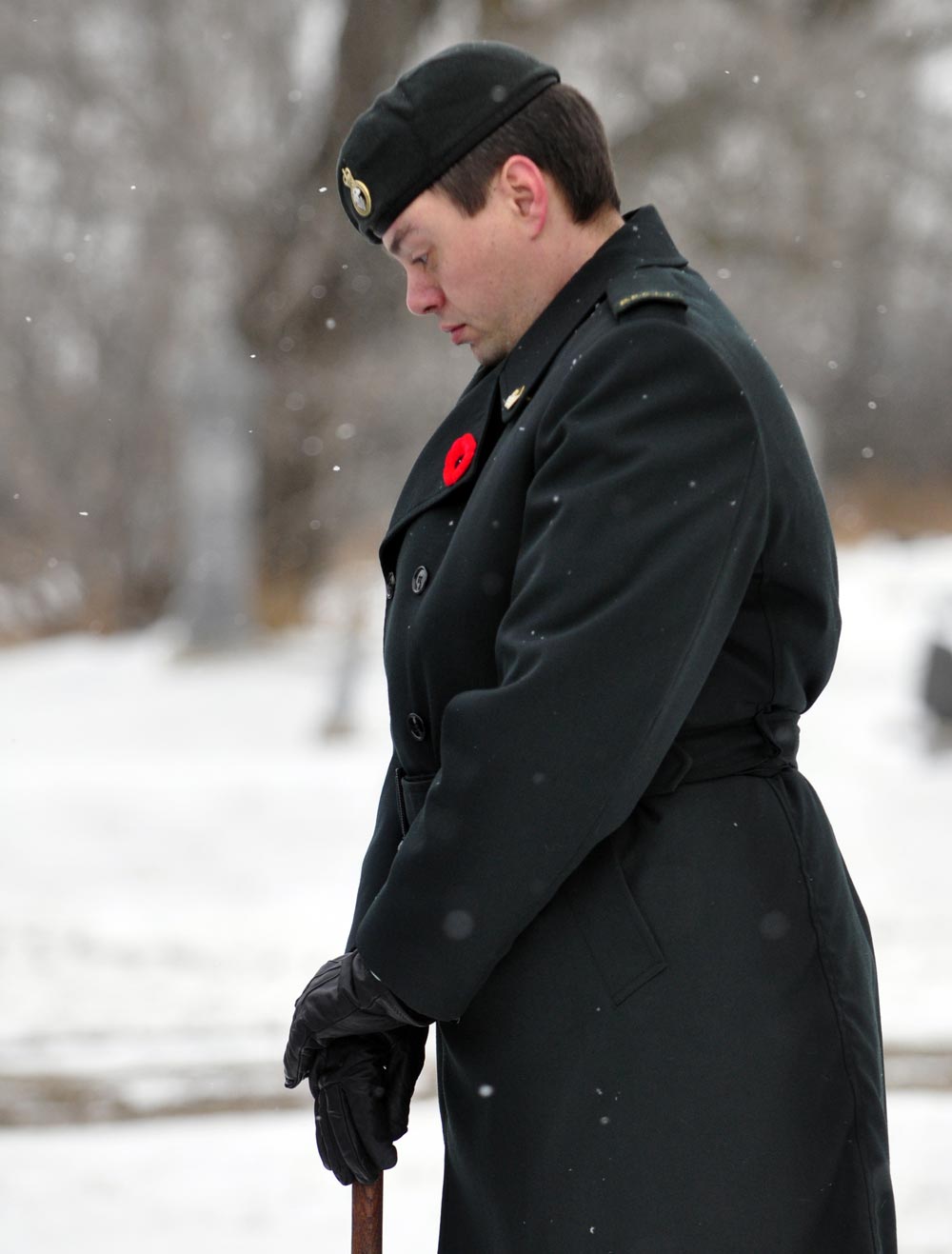
During the solemn ceremony at Sgt George Mullin’s snow-covered grave in the south cemetery in Moosomin, Sask., 2PPCLI’s Lt John-Tolfin Pallasigui and Sgt Alex Helbren salute, as they did later during a wreath-laying ceremony at the town’s 1924 cenotaph. Young soldiers listened intently to B Coy’s Cpl Mackenzie Shambrook telling the story of Sgt Mullin’s heroics in Passchendaele, France on Oct. 30, 1917 which led to his Victoria Cross. Another soldier used his iPhone camera to take a photo of the gravesite. The World-Spectator associate publisher Kara Kinna used her Canon telephoto lens to focus on the grave site ceremony, light flurries falling from the overcast sky. 2PPCLI marched from the Moosomin Legion to the cenotaph as part of the town’s Remembrance Day ceremonies. The Victoria Cross is the highest award for gallantry in the face of the enemy which can be awarded to British and Commonwealth forces. Photos Jules Xavier/Shilo Stag