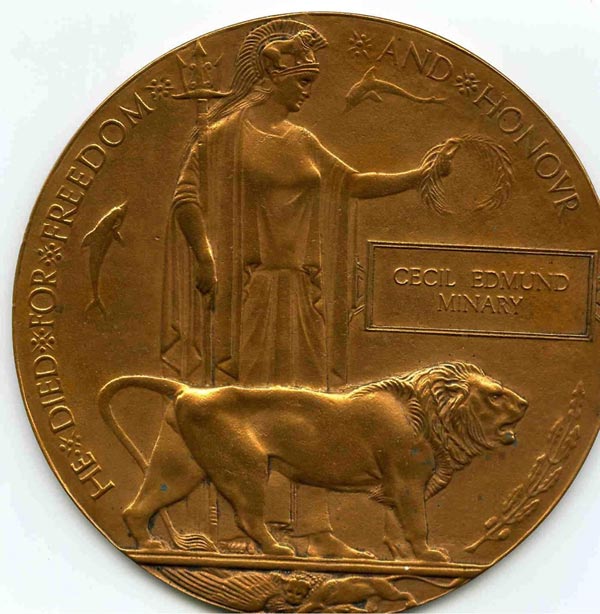


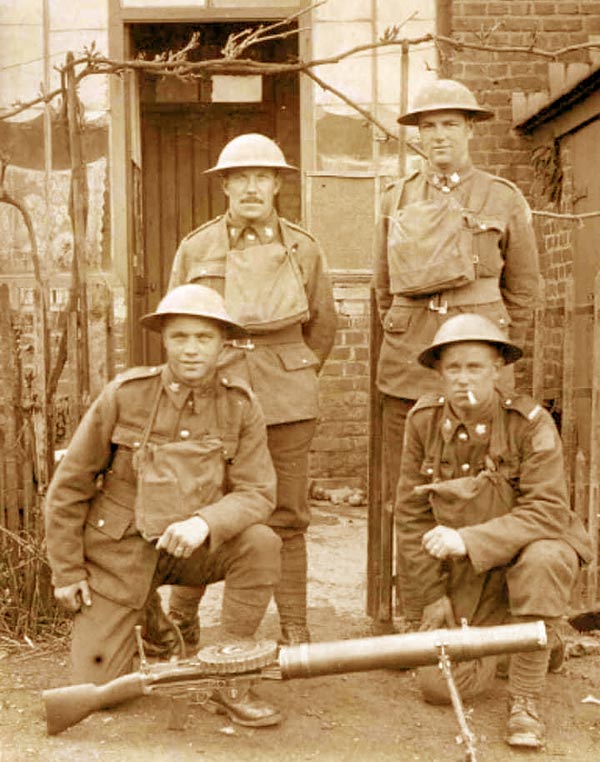
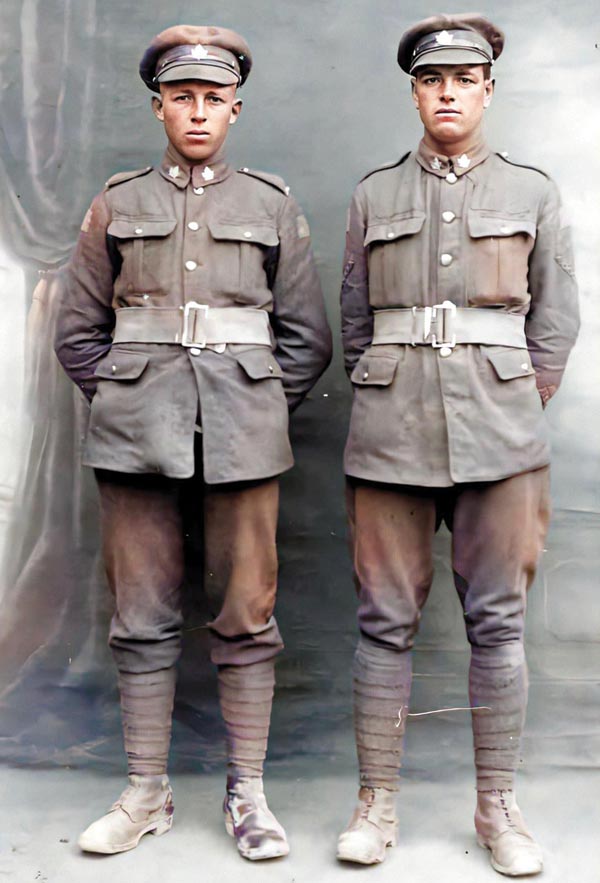
Standing inside the family bakery on the main drag in Souris, Kendra Minary looks over a Great War portrait of her great-great-uncle Pte Cecil Minary. She has an assortment of Great War photos of Pte Minary, which she cherishes. Photo Jules Xavier/Shilo Stag
Jules Xavier
Shilo Stag
Kendra Minary likes to say she was born in the wrong generation.
A quarter-century old, she likes vintage Volkswagon Beetles, kitchen dishes, century homes and anything associated with the Great War, especially when it comes to her great-great-uncle Pte Cecil Minary.
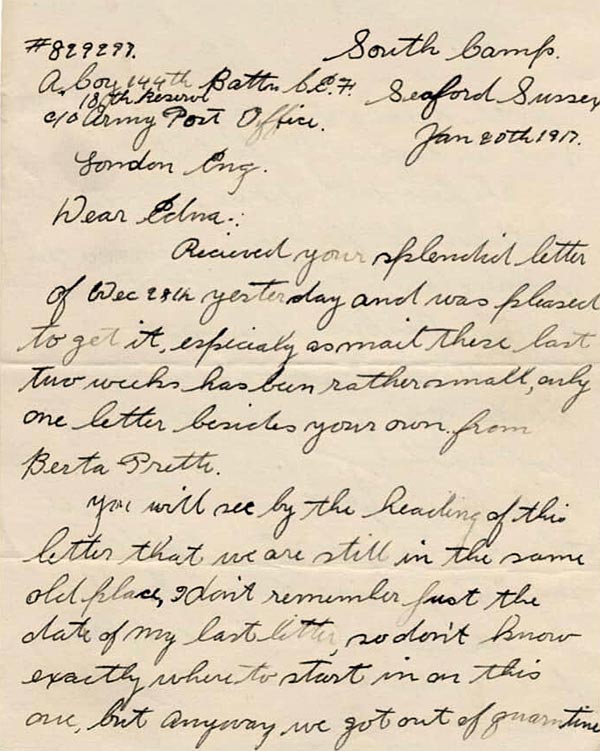
He enlisted in Winnipeg on Nov. 30, 1915. At age 20, he joined the 144th Battalion, better known as the “little black devils.” It was a labour of love whe the COVID-19 pandemic started in March 2020, with Kendra having the time to painstakingly transcribe a mountain of letters penned by her great-great-uncle during the Great War. Letters were initially written from Camp Hughes, then England, followed by France when he was deployed after further military training.
Born in Brandon, but raised in Souris where she works for the family bakery on main street, Kendra has been researching her family ancestry with passion, reaching out to relatives as far away as Vancouver Island.
“It’s something I have always had an interest in, but never took the full dive into it until about a year or two ago,” she says.
Besides learning about Pte Cecil Edmund Minary, who served with the 144th and 52nd Battalions as a Lewis machine gunner, she has learned her great-grandpa William Bruce Minary — Cecil’s younger brother — was also in the First World War, serving with the railway/engineers construction troops.
Then there’s distant cousin — first cousin, twice removed — Cecil Andrew Minary, who was an RCAF wireless air gunner/operator during the Second World War.
Andrew and Martha (nee Patterson) Minary were Pte Minary’s parents. They built what is now the Minary century house east of Souris in a rural setting surrounded by pasture and crop fields.
There were seven children besides Cecil Edmund and William Bruce — siblings included James Victor, Annie Ellen, Robert Arnott, Victoria Mae and Andrew Roy. Pte Minary’s mother Martha died giving birth to Andrew Roy in the living room of the century home, while father Andrew died a few years later in a car accident.
With an interest in history during high school, this subject actually piqued Kendra’s pursuit of learning more about her family and their involvement in Canada’s military.
“War history has always fascinated me and it’s so neat to now be able to connect my family members to the war[s],” she says. “After receiving a bunch of family photos and the copies of Cecil’s letters from a cousin [in 2019], it really got me interested in finding out more of Cecil’s story.
She added, “My distant cousin Denny was the first one to really dig into the family history, get DNA tests done, and research Cecil. He, unfortunately, lost a battle with cancer a few years ago so I’m just trying my best to continue on where he left off.”
Having just completed a Minary family tree going back to the late 1700s, Kendra says this research has led her to discover distant cousins from BC and Alberta which she had no idea existed.
Born on July 6, 1895 in Nesbitt, Pte Cecil Minary trained at Camp Hughes prior to going overseas, where he saw action after the Battle of Vimy Ridge was underway. Being with the 52nd Battalion, he was in reserve in April 1917 when fighting started in what many historians considered to be Canada’s greatest military victory.
“While in early training at Camp Hughes he very nearly died from pneumonia,” she said, acknowledging in the days before antibiotics it took him more than seven months to recover prior to returning to Camp Hughes to complete training. He left for England on Sept. 18, 1916 aboard a troop-laden SS Olympic.
The eldest of his seven siblings, Pte Minary grew up on the Nesbitt family farm, and was known for his baseball prowess playing alongside his brothers.
There’s a good reason why Kendra became more interested in her family tree, especially those who served their country.
“I feel it is important to honour and remember them and the sacrifices that they made. And to ensure that they are never forgotten,” she says.
Kendra has the luxury of Pte Minary’s numerous letters he started writing while overseas 106 years ago, and mailed to family back in Manitoba.
While they don’t describe the muck and mire of the battlefield he fought on because of censorship, Kendra says his words demonstrated his love for family and missing being at home.
“Cecil loved and missed his family dearly. He was there to do his duty and couldn’t wait to go back home.”
With his unit in an out of battle lines until at least August 1918, Kendra says her great-great-uncle’s letters did describe some close brushes with death and of friend being wounded or killed.
“Cecil seemed to have had a charmed life because in the same action, he was only shot through the heel of his boot. There is little in his letters to suggest of the horrors and hardships we now know these men endured. In fact, he would appear to do his best to make light of it all.”
Pte Minary was Killed in Action (KIA) on Aug. 28, 1918 during the 100-day push, with CEF soldiers and their allies pushing the Germans back from territory they held for much of the four-year war.
“[Cecil] and his crew of six other men were hit by an artillery shell near Bois Du Vert, France — six of the seven men, including Cecil, were killed,” says Kendra.Fo
Following his death, he was buried in the Vis-En-Artois British Cemetery in Pas de Calais, France.
Learning about Pte Minary’s death while researching his attestation paperwork, Kendra was heartbroken.
“Especially knowing it was so close to the end of the war,” she laments. “Reading the 52nd Battalion war diaries, I believe the battle which he was killed was one of the last major battles they fought before going back on reserve, so had he of just survived that, he likely would have survived the rest of the war.”
Carrying no rifle, just a revolver, Pte Minary handled the Lewis machine gun when his group was in action facing the Germans.
While visiting her great-great-uncle’s century home in Nesbitt, Kendra thinks about him while she walks in a house no longer habitable. If the walls could only tell stories.
“Walking through that home, knowing he walked out that door, at such a young age, never to return, hits pretty hard,” she says.
If she had a chance to talk to Pte Minary today, what would she ask him about life in the CEF and growing up on the Minary farm?
“I would love to talk to him about his childhood and life growing up on the farm in Nesbitt. What made him choose to enlist? What were the most rewarding parts of being a soldier? What were the hardest parts of being a soldier? And, of course, I would love to be able to thank him for his bravery and all that he gave for our country.”
Having transcribed all of his mailed letters scribbled mainly in pencil, Kendra has learned something about her great-great-uncle based on the words on letters currently housed at the Wawanesa Museum.
“Something that has really stood out to me is how each letter is so cheery, regardless of the things he was experiencing,” she offers. “He rarely described the hardships of war we now know they endured.
“Which could partially be because of the letters being censored, but he still always seemed to be so positive and made light of each situation he experienced.”
She added, “The letters written by his dad and sister in August 1918 are heartbreaking to read, knowing they either weren’t sent out in time or were sent back because of Cecil’s death.”
Researching one’s family tree, and accessing military records, has been made easier thanks to the Internet and an array of websites Kendra peruses on her laptop. She has joined military Facebook groups, used Google, and visited sites like ancestry.ca and myheritage.com for further details.
“My relatives have helped by sharing any memories [they have], information and photos that they have,” she says. “I have found so many great, helpful Facebook groups. Also a simple Google search can go a long way.”
To give our readers a view of the Great War from a soldier who trained at Camp Hughes, and paid the ultimate sacrifice serving his country, Kendra is sharing her great-great-uncle’s letters with the Stag’s website as she did with the now defunct 75-year-old Shilo Stag newspaper.