

Shilo Stag Media
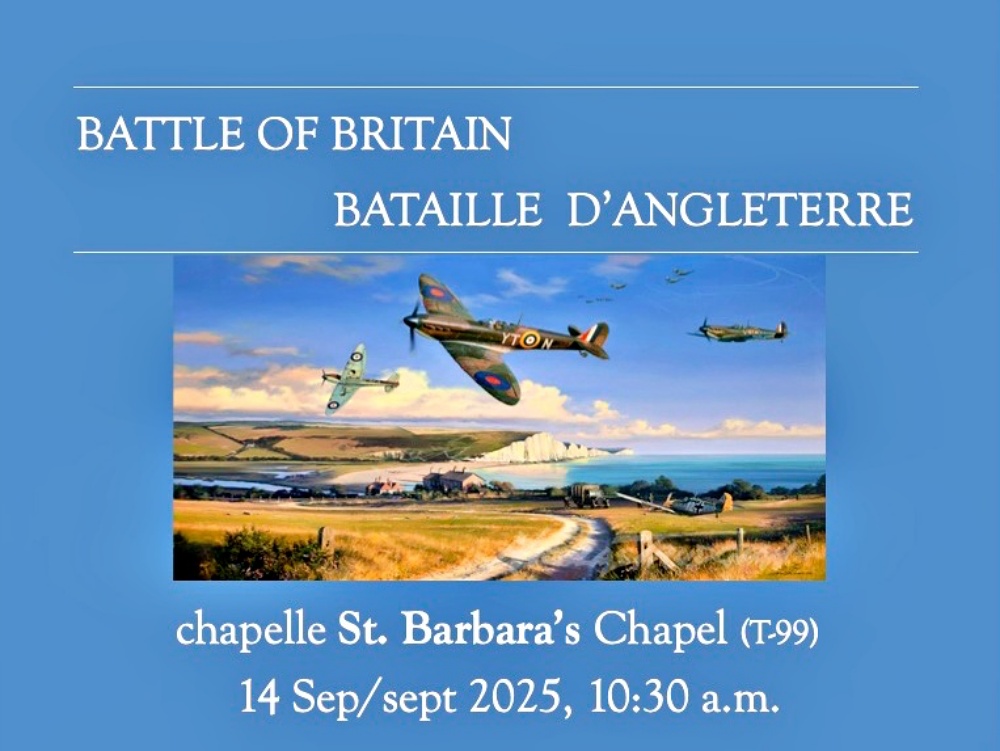
The lives and contributions of more than 100 Canadian Armed Forces members are being remembered in the 85th anniversary services for the Battle of Britain at St. Barbara’s Chapel on Sept. 14.
The CFB Shilo service starts at 10:30 a.m. to commemorate the actions of the small group of allied fighter pilots against the far larger German air force, the Luftwaffe, during the epic and renowned battle.
The Battle of Britain, fought in the skies over Europe, was immediately recognized as the largest and most significant air battle to date. Its implications were indicative of a possible invasion, and it was known to be the determining factor of that invasion’s cessation.
In June 1940, Britain remained stalwart, refusing to surrender its freedoms after France fell to German occupation. The Nazi intent was to conquer Great Britain, giving themselves a free rein in Europe. They entered into the trial for conquest, knowing they would have to defeat the already depleted Royal Air Force (RAF) before commencing their invasion under Operation Sea Lion.
While many Canadians had already made their way abroad during the 1930s to join the RAF, the Royal Canadian Air Force (RCAF) numbered at just less than 5,000 personnel when war was declared on Sept. 10, 1939.
Despite the need for aircraft to protect home soil defence, with Britain’s back against the wall, Canada dispatched modern Hurricane fighters with No. 1 (Fighter) Squadron.
Canadians flew as members of the RAF units during the several months it took for No. 1 Squadron to become operational. No. 242 Canadian Squadron had made a name for itself during the Battle of France.
On Aug. 12, 1940, the Luftwaffe began destroying RAF coastal airfields. The relentless attacks resulted in numerous casualties among the groundcrew and support workers. In between the barrages, these personnel would rush to treat the injured, gather the dead, fill bomb craters, put out fires, and complete hasty repairs to damaged aircraft. They would rearm and refuel the returning fighters.
The casualty numbers grew each day, and the Canadian No. 1 Squadron was now in the midst with Spitfires and Hurricanes clashing with German bombers and escorting Messerschmitt fighters several times a day. The usually quiet and serene English countryside became strewn with blackened and burned-out bodies of aircraft and young men.
On Sept. 7, the Luftwaffe pivoted its focus to its attacks on London and other large cities. The bombardments became known as “The Blitz”. These few days have become etched in history by the inner strength and courage of British citizens enduring the constant deluge of bombs 24 hours a day.
The fighting escalated to its pinnacle on Sept. 15, when the Germans rained a hail of aggression on London, making it a decimated victim.
More than 1,500 aircraft engaged in the combat clash that day, with the Allies turning the tables to destroy every two enemy aircraft for their loss of one.
No. 1 Squadron were victorious twice that day, claiming three destroyed enemy aircraft, three likely destroyed and two heavily damaged while mourning the loss of one No. 1 Squadron pilot and two Hurricanes.
On Sept. 17, completely irate with the Luftwaffe’s inability to overthrow the RAF, Hitler postponed the invasion of Britain. On Oct. 12, the German commander advised his service chiefs that Operation Sea Lion had been delayed until Spring 1941. In fact, Hitler had already turned his attentions toward Russia and the invasion of Great Britain was never again seriously considered.
For almost two months, 57 consecutive days and nights, German bombs crushed London, and Britain suffered a total of nine months of aerial bombardment of their cities.
More than 100 Canadians participated in the Battle of Britain, which took place from July 10 to Oct. 31, 1940. No. 1 Squadron was the only Canadian Unit to take part. The RCAF’s No. 1 Squadron was soon renamed to 401 Squadron.
According to the Government of Canada website, “In the 53 days of combat, these young Canadians claimed the destruction of 29 enemy aircraft, eight possibly destroyed and a further 35 damaged.”
However, it was not without cost as the squadron lost 16 aircraft and the lives of three pilots. A further 10 personnel were wounded.
Canadian Armed Forces members and personnel distinguished themselves, but they were not alone. Aircrew from 13 nations fought as part of the RAF’s Fighter Command. Battling alongside British and Canadian troops were personnel from Australia, New Zealand, Belgium, Czechoslovakia, France, Ireland, Jamaica, Poland, South Africa, the U.S.A. and Zimbabwe.
Two thousand, three hundred and fifty-three pilots from Great Britain and 574 from overseas participated in the Battle of Britain. Five hundred and forty-four allied airmen and personnel were killed, including 23 Canadians.
“All those who flew at least one authorized operational sortie with an eligible unit of the Royal Air Force or Fleet Arm from July 10 to Oct. 31, were awarded the Battle of Britain clasp to the 1939-45 Star,” the Govt. of Canada website states.
Three members of No. 1 Squadron received the Distinguished Flying Cross for valiant efforts during the Battle of Britain: CO Squadron Leader Ernie McNab, his second in command Flight Lieutenant Gordon Roy McGregor, and Flying Officer “Dal” Russel. Two Canadian ground crew members were recognized for their contributions: Flight Sergeant John R. Burgess was awarded the British Empire Medal, and Flight Sergeant Cecil M. Gale was mentioned in dispatches.