

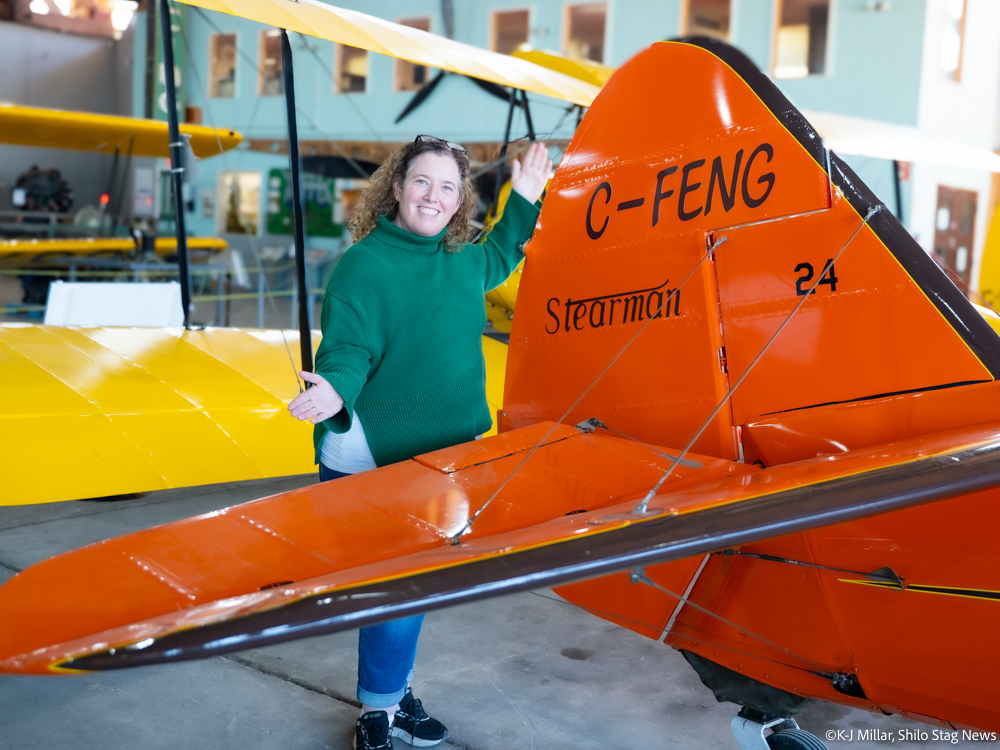
Zoe McQuinn, Director General of the Commonwealth Air Training Plan Museum in Brandon, said the Boeing Stearman PT-27 was donated by a Winnipeg man who viewed the plane as a way to connect with the history of those who served. (Photo: K-J Millar/Shilo Stag News)
K-J Millar
Shilo Stag Media
The bright flame-coloured 1943 PT-27 Boeing Stearman Kaydet aircraft sits in the middle of the Commonwealth Air Training Plan Museum (CATPM), hot as fire, being the newest asset on display in the Brandon hangar since its arrival on Oct. 2.
Due to the delicate and specialized work, costs will surmount more than $80,000 to $100,000 in restorative procedures to return the flying machine to its authentic wartime paint scheme of training daffodil yellow, said Zoe McQuinn, Director General of the CATPM, on Oct. 8, when the Shilo Stag had the opportunity to view the biplane and learn some of its history.
First flown in Kansas in 1934, the Stearman quickly became one of the most critical training aircraft of the Second World War.
“The Stearman will be both a teaching tool and a flying artifact – part of CATPM’s unique role as an active heritage hangar,” McQuinn said. “Our goal is to bring history to life through sights, sounds, and experiences that connect people personally with the story of service, courage, and innovation.”
Stearman Kaydets are a legendary training aircraft that played a key role in preparing Allied pilots during the Second World War. The RCAF used more than 300 of the PT-27 models as trainers in Elementary Flying Training Schools across the prairies in 1942.
First flown in Kansas in 1934, more than 8,400 PT-27s were built. It’s estimated that more than half of all U.S. military pilots received their initial flight instruction in the open-air Stearman.
Now, more than 83 years later, one has found its wings to land home at the CATPM.
The currently flightworthy plane arrived at the museum in early October as a gift from its previous owner, Gerry Pap of Winnipeg. Like many Stearmans, it was converted to civilian use after the Second World War and painted bright tangerine.
The museum director general said the aircraft was maintained with care while respecting its significance to our past. Pap was not a pilot himself, she said; however, he viewed the Stearman as a way to connect with the history of those who served.
“Many people express their connection to the past and to their own identity through the care and preservation of historic artifacts like this one… Gerry’s relationship with the museum reflects that same spirit of stewardship.”
The classic biplane adds a new dimension to its aviation collection, McQuinn said.
“… It helps bring to life the stories of courage, innovation, and service that shaped the British Commonwealth Air Training Plan (BCATP).”
The CATPM’s goal is to complete the restoration of the plane within two years through various support and fundraising efforts.
“We’re inviting everyone who values history to take part – whether through donations, volunteering, sharing experiences, or simply visiting us. Every dollar helps us to keep the stories alive,” McQuinn said.
The plane is already on display in the main hangar and available for the pubic to view during open hours of 1 p.m. to 4 p.m. daily until Nov. 12, when the museum will close for the winter. The plane will be part of the public programming and flying schedule in 2026.
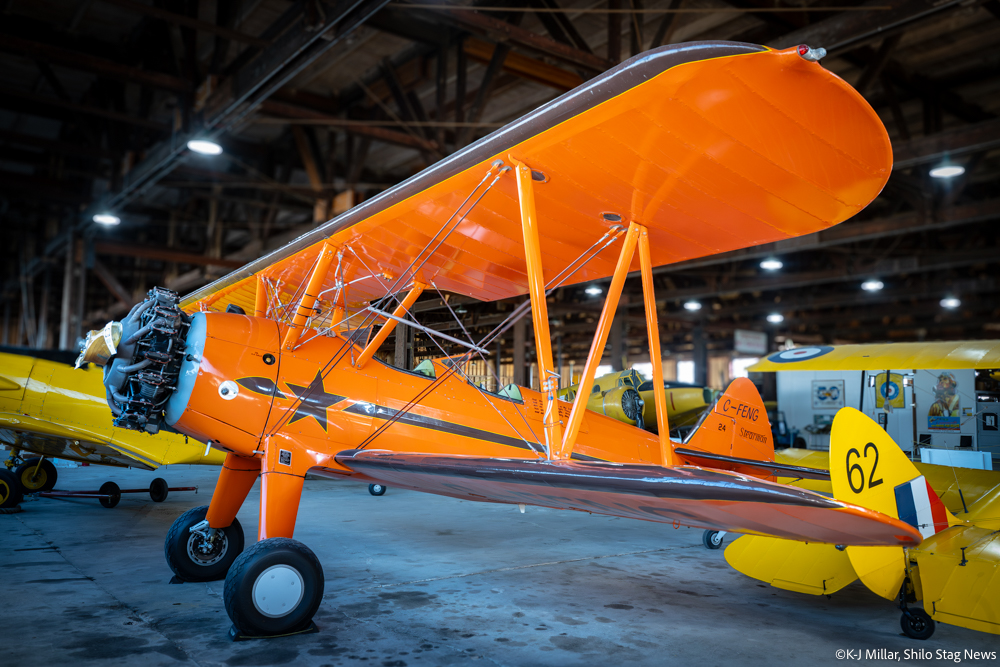
The 1943 Boeing Stearman Kaydet aircraft was gifted to the Commonwealth Air Training Plan Museum in early October. The goal is to have it restored to its authentic training yellow colour. (Photo: K-J Millar/Shilo Stag News)