
Jules Xavier
Shilo Stag
It’s an arduous task trying to restore a more than century-old 150 mm German Howitzer used during the First World.
But that’s what RCA Museum chief mechanic Rob Love is doing in the curatorial centre across the road from Base HQ.
“The barrel went out of battery probably 100 years ago up at Sturgeon Lake, Ontario,” offers museum director Andrew Oakden. “It came back [to Canada] with all the other small and medium German artillery after the war. The 67th Battery out of Toronto acquired the gun for their cottage and annual retreat at Sturgeon Lake.”
A few years ago, Oakden travelled to Sturgeon Lake and met with the new owners and they agreed to donate the gun to the museum.
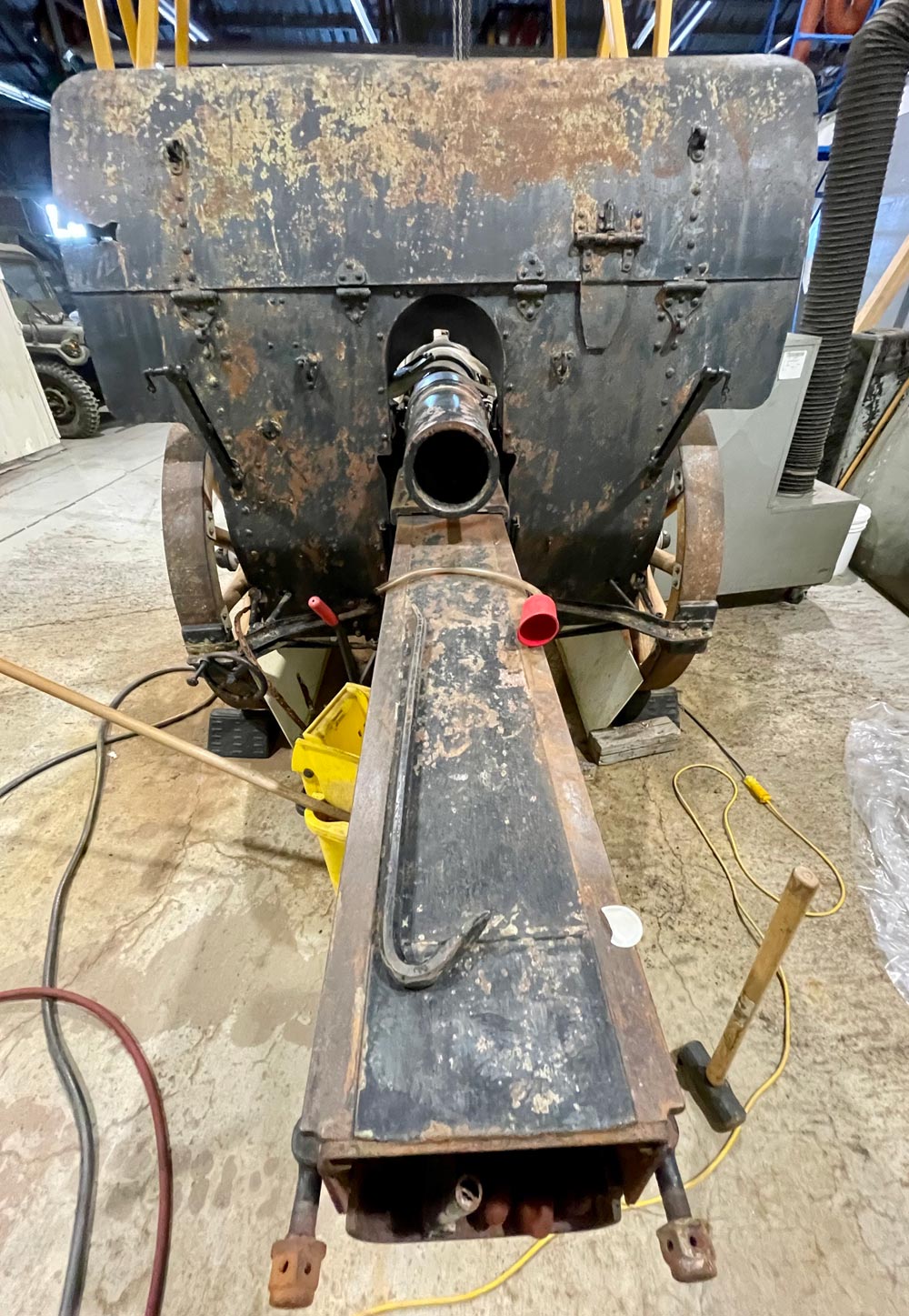
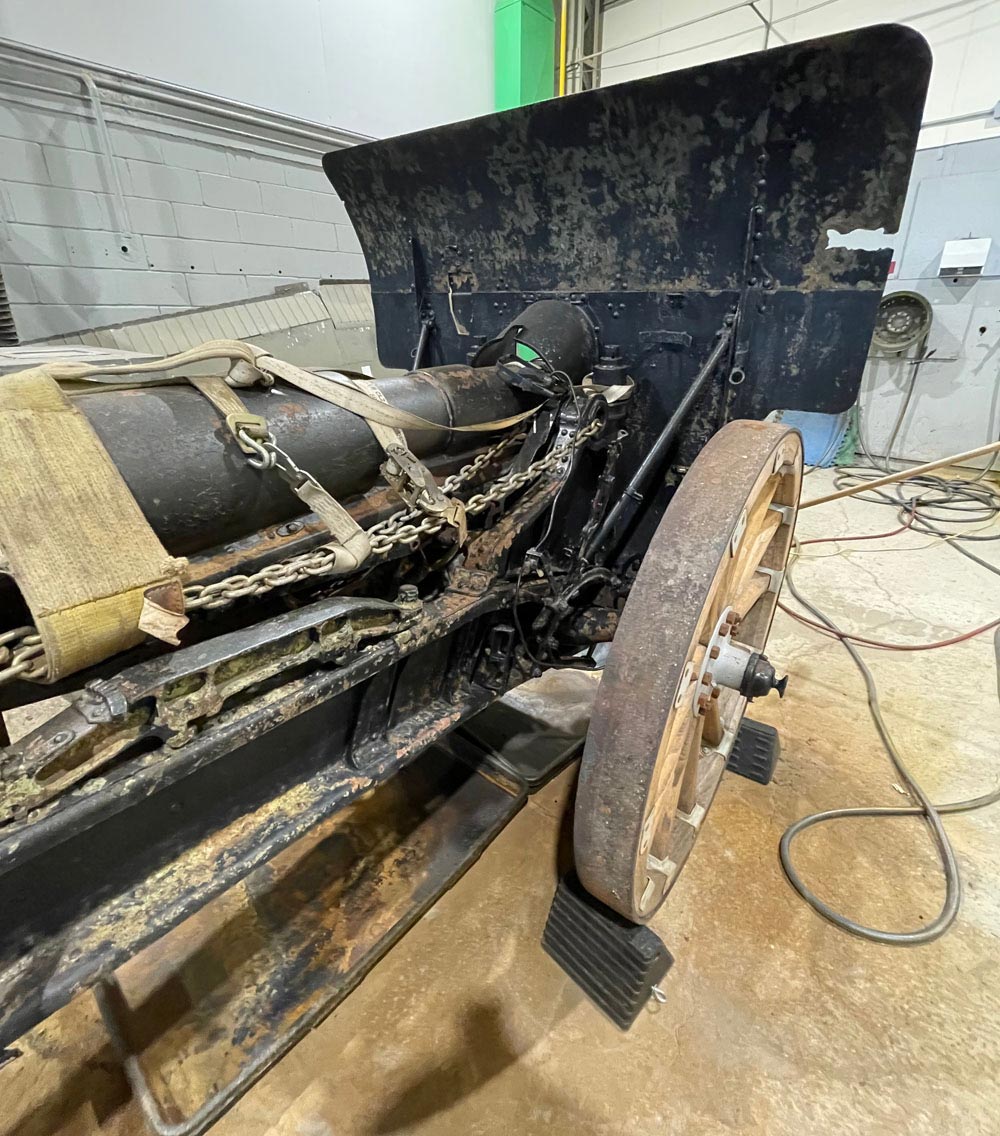
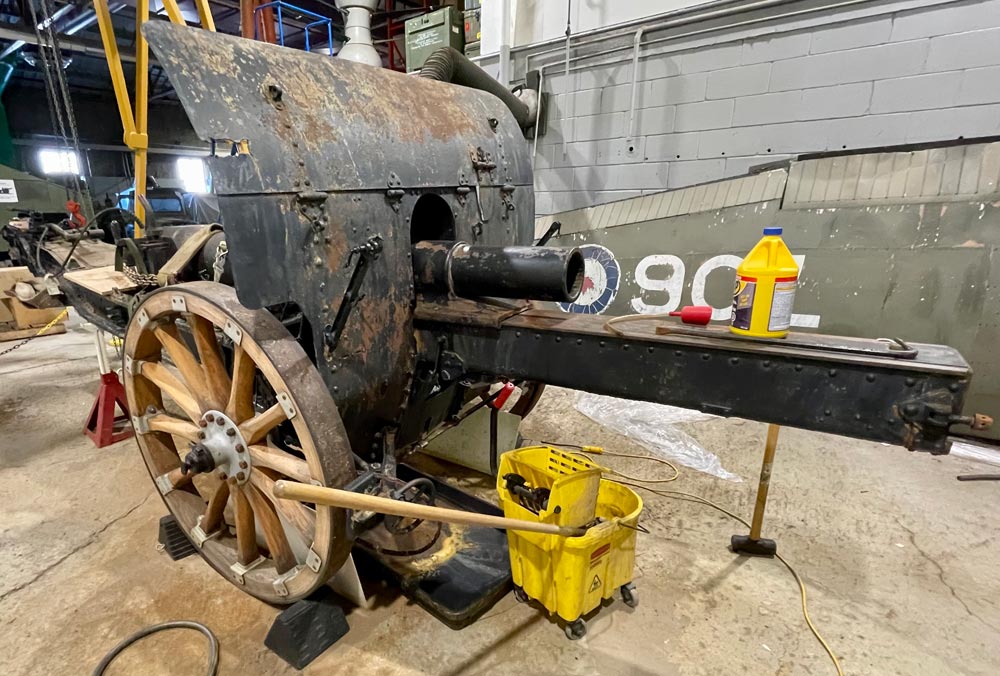
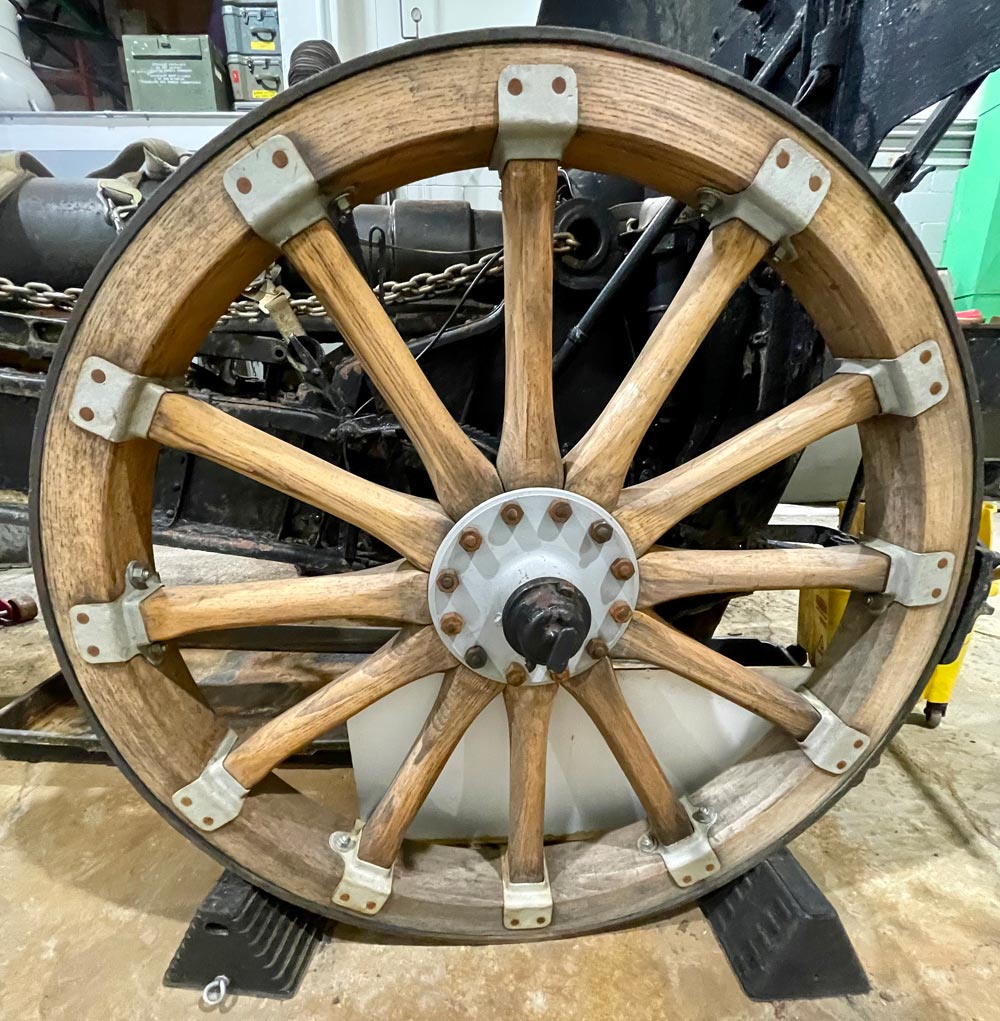
“We then had the wheels restored and Rob is moving forward with the restoration. He is working on getting the barrel back into battery. Basically, over 100 years the barrel has rusted to the carriage and he’s using acid to remove the rust. He’s about 90 per cent done with the rust removal and the barrel should pop soon and then he can push it up back into battery. Right now the barrel is a couple of feet low. Then he’ll fix some of the metal problems and paint it.
According to Oakden, from 1930 to 1974, veterans of the 67th Battery Association met every summer at the “Chateau de la Haie” near Sturgeon Lake. The 67th “Varsity” Battery was, in part, raised from students from the University of Toronto. The men from the 67th Battery would go on and fight in the Great War. They certainly shared a unique bond, and after the war, they established the 67th Battery Association.
Of note, Oakden said the cabin at Sturgeon Lake has a noteworthy history.
“The original log cabin was built in the 1830s. It was the pioneer home of Jabez Thurston and family. In 1930, the cabin was acquired by the 67th Battery Association and given the name ‘Chateau de la Haie’ in honour of a stately chateau in France that had served as Canadian Corps Headquarters in the First World War.”
Following the Great War, hundreds of German war trophies arrived in Canada after crossing the Atlantic Ocean and were distributed to communities across the country. One of the war trophies, a 150 mm German heavy artillery long barrelled howitzer went to Varsity Stadium at the University of Toronto. The gun stayed at the stadium for approximately 20 years before the 67th Battery Association acquired it and moved it to the Chateau de la Haie at Sturgeon Lake in 1939.
In discussions with the Soldiers’ Tower and Carillon at the University of Toronto, who honour the memory of the 67th “Varsity” Battery, Oakden noted more than 100 U of T students, including some from the 67th “Varsity” Battery, also served in Russia and Siberia during the North Russia Intervention (1918-1919).
The gun itself now being worked on by Love is a 15 cm sFH13 designed by Krupp Company in Germany — 3,409 were built from 1913 to 1918. The howitzer has a horizontal sliding-breach block and a basic hydro-spring recoil mechanism. There were three variants including the original sFH13 with short barrel, the lg. sFH13 L/17 with long barrel, and the simplified lg. sFH 13/02.
For the museum’s acquisition, this particular gun is the original 15cm sFH13 with a replacement L/17 long barrel. The barrel would need replacing after firing 20,000 to 25,000 rounds.
“The Allies referred to the gun as ‘Fine-Nines’ or ‘Five Point Nines’ due to the internal diameter of the barrel at 150mm or 5.9 inches,” offered Oakden. “These guns delivered heavy firepower with a shell weighing approximately 42 kilograms and an effective range up to 8,800 metres.”
These guns continued to be used after the Great War, until the sFH18 was introduced in the 1930s. The RCA Museum has a sFH18 displayed in its outdoor gun park.
In 1974, according to Oakden, the cottage was sold. By this time, the majority of the war veterans were in their 80s. In 1990, Celia Devov and Robert Bell purchased the cottage which still had the German Great War artillery piece sitting out front.
In June 2018, Celia and Robert contacted BGen (Ret’d) Ernie Beno regarding the possible donation of the First World War German howitzer. In July 2018, Oakden had an opportunity to visit Celia and Robert at their lakeside property.
“I inspected the gun and it certainly appeared intact [after being] placed in the same spot for every bit of 77 years. The gun has been painted many times, which has protected the metal from rust damage and the elements,” he recalled. “Unfortunately, the wooden wheels had not faired well and are in need of replacement. The barrel is fully recoiled and requires some restoration.”
Looking back at the acquisition, Oakden said Love felt the gun could be restored — the existing paint needed to be stripped; then rusted or damaged portions fixed or replaced, and repainted; the wooden wheels would need to be rebuilt.
So, after talking about what needed to be done, Oakden had Love head for Ontario to pick it up on July 6, 2019. Arriving back at CFB Shilo, the gun was placed in the museum’s restoration schedule, with the wheels being the first priority for replacement using rebuilt wheels.
Another challenge for Love was moving the breech and tube to the appropriate position.
Once the restoration is completed, Oakden said the gun could be showcased inside or perhaps outdoors at the gun park.
“We are very thankful to Celia Denov and Robert Bell for the donation. Having an artifact that belonged to the 67th ‘Varsity’ Battery Association will certainly help us to inform visitors about Canada’s role during the First World War. We will honour the memory and legacy of Canadian Gunners who fought in the First World War and the North Russia Intervention. These guns were used extensively during the First World War and it is currently missing in our collection.”
It’s an arduous task trying to restore a more than century-old 150 mm German Howitzer used during the First World, but RCA Museum chief mechanic Rob Love is up to the challenge. With restored wheels in place, and extensive work being done on the barrel, the project is nearly 90 per cent complete. Work is being done at the museum’s curatorial centre. Photos Jules Xavier/Shilo Stag