


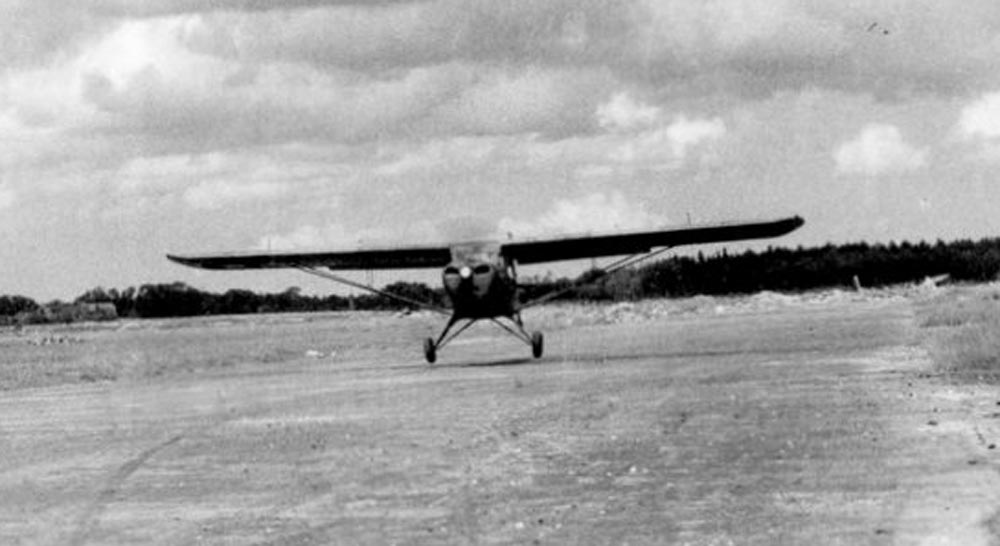

Lt E.J. Ambrose took many photos from the window of an Auster in flight documenting the extensive artillery bombings of German enemy territory, including bombed-out buildings. An Auster takes flight in the Bad Zwischenan, home to one of the largest Luftwaffe air bases in North-West Germany. Lt Ambrose (center) posed alongside fellow pilot Lt Jones (left) and an unnamed colleague. RCA Museum supplied photos
Andrew Oakden
Stag Special
You may be surprised to learn Canada had three Air Observation Post (Air OP) squadrons during the Second World War.
The Royal Canadian Artillery (RCA) formed three Air OP squadrons under the Royal Air Force’s (RAF) command. The first two squadrons, #664 and #665, participated in Air OP missions in the Netherlands and Germany starting in 1945.
Their primary operational role was to direct artillery fire from the air to enemy targets. There is an excellent secondary source entitled Canada’s Flying Gunners by LCol (Ret’d) D.L. Fromov which documents this proud RCA history.
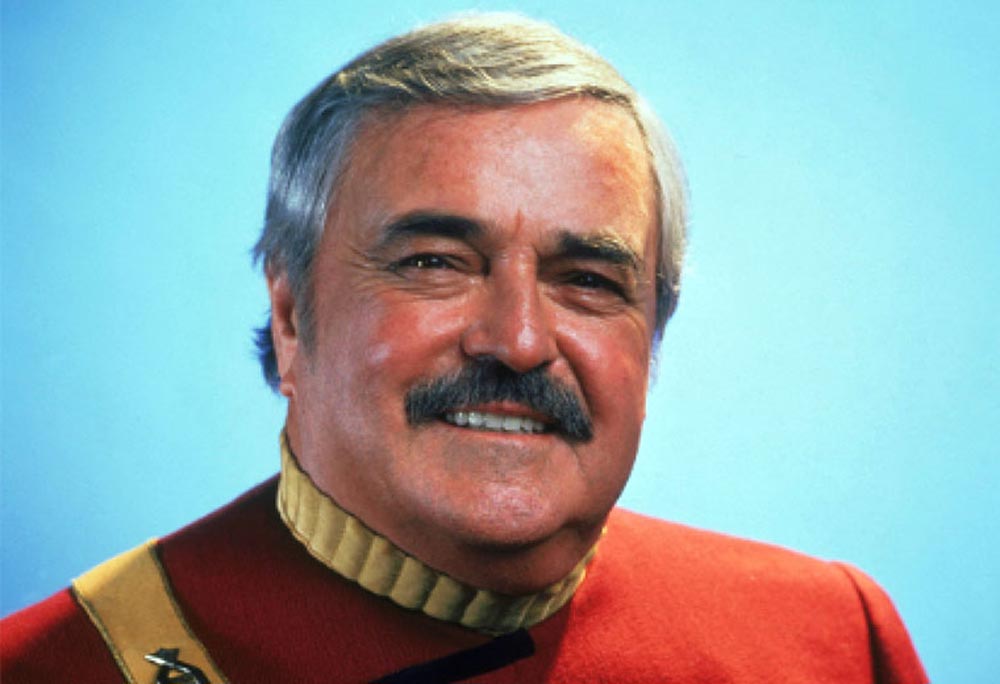
A famous Canadian Gunner and Air OP pilot was Capt James Doohan (1920 – 2005), who played Scotty on the TV series Star Trek. He was part of the third squadron #666.
He recalled, “You had to be some sort of a fool to volunteer [to be an Air OP pilot] or have a strong desire to fly.” Being an Air OPs pilot meant extensive low-level flying essential to evade enemy aircraft and ground fire.
The RCA Museum has a scrapbook from Lt E.J. Ambrose, an Air OPs pilot who was part of No. 664. He qualified from the first of six Air OP courses for Canadian Gunners, course #37.
In a Dec. 19, 1944 photograph of the first qualifying graduates — Lt Ambrose in the back row center — they certainly all look proud of their achievement.
The RAF formed Squadron #664 on Dec. 9, 1944. Pilots trained at #2 Elementary Flying Training School RAF in Cambridge, England, then at Larkhill, England.
The first Commanding Officer (CO) of #664 was Maj Dave R. Ely. They were under the command of 70 Group RAF Fighter Command in England. In December 1944, they had 16 Auster Mark IV aircraft, and in January 1945, they were ready for deployment.
The RCA Museum is fortunate to have an Auster Mark V from the period in our storage facility. During the Second World War, the three Canadian Air OP squadrons deployed Auster Mark IVs and Mark Vs.
In the future, we will display the Auster Mark V in our museum. Curators have discussed elevating the Auster approximately 20 feet in the air in the Second World War section to save on floor space, which will help tell an essential Gunner story.
In March 1945, #664 deployed to the Netherlands and participated in operational missions over enemy territory. Once deployed, they transferred to No. 84 Group Second Tactical Air Force (2 TAF).
During the final phase of the Second World War, Air OP pilots helped locate enemy targets in Holland. By May 4, #664 was operating in Northwest Germany, proving highly mobile and able to fly at a moment’s notice.
They completed missions for the 1st Polish Armoured Division, 1st British Corps, and HQ Netherlands District. After VE Day, the squadron continued flying duties for the Canadian Army Occupation Force until early 1946 — #664 disbanded on May 31, 1946.
The RCA Museum is fortunate to have the photo album of the first Canadian Air OP squadron, #664, and lucky to have an Auster Mark V in our collection.
They both help tell an important story about the Canadian Air OP squadrons and Canadian Gunner pilots during the Second World War.